

A meeting with the Portuguese artist during Lisbon Design Week reveals a practice shaped by intuition, memory, collaboration, and the quiet intelligence of fiber.
Meeting Maria Pratas was one of the unexpected highlights of our Lisbon Design Week experience.
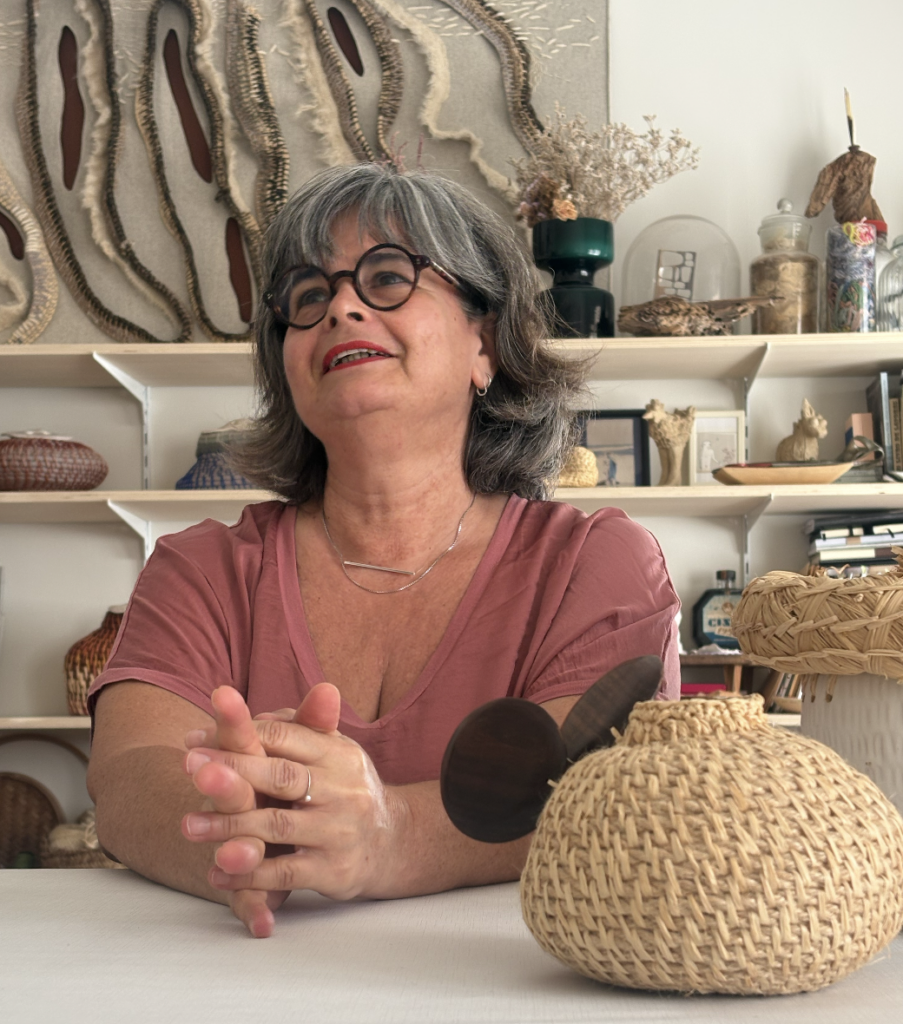
A powerful woman with a short bob haircut and round eyeglasses, she welcomed us warmly at Sal Atelier, just as she was finishing a conversation with another visitor interested in her work. There was no theatrical entrance, no distance between artist and audience. Maria’s presence was direct, generous, and immediately alive.
During Lisbon Design Week, she spent much of her time at Sal Atelier, the space owned by her friend and creative partner, Sofia Albuquerque. Together, they presented Saloias, a joint project where fiber and clay meet through memory, rural heritage, and contemporary craft.
Maria’s own studio and home are only a few meters away from the atelier. After our first exchange, she invited us to follow her there.
Inside Maria Pratas’ Home Studio
A small, almost anonymous door opened into a world that felt entirely her own.
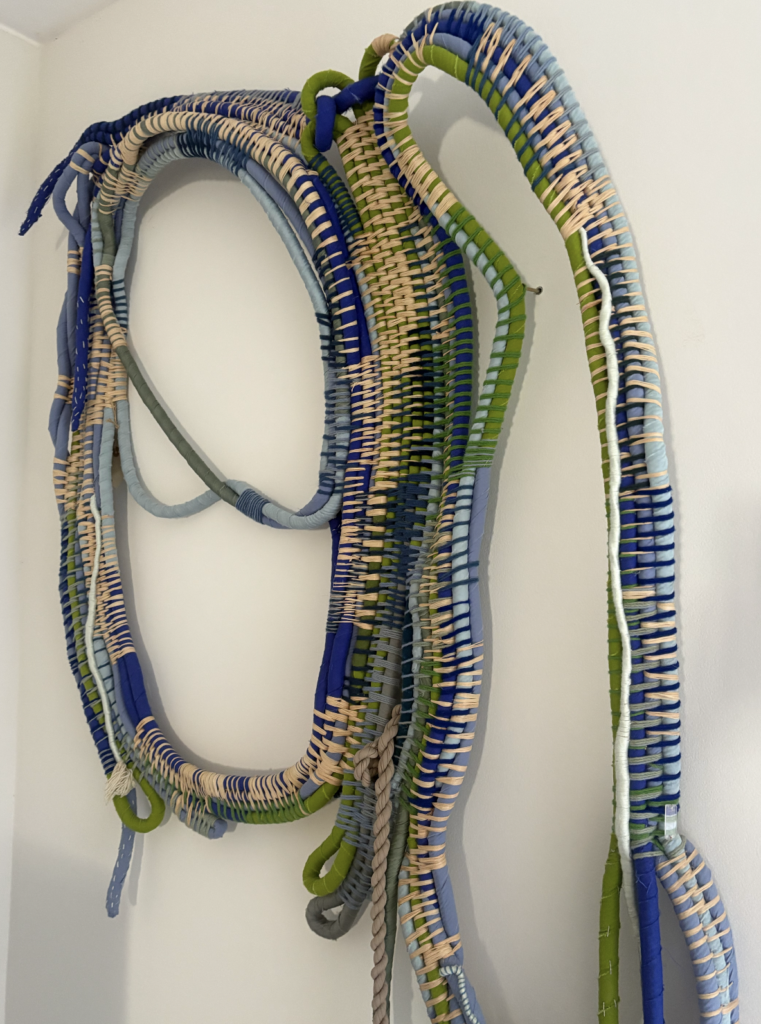
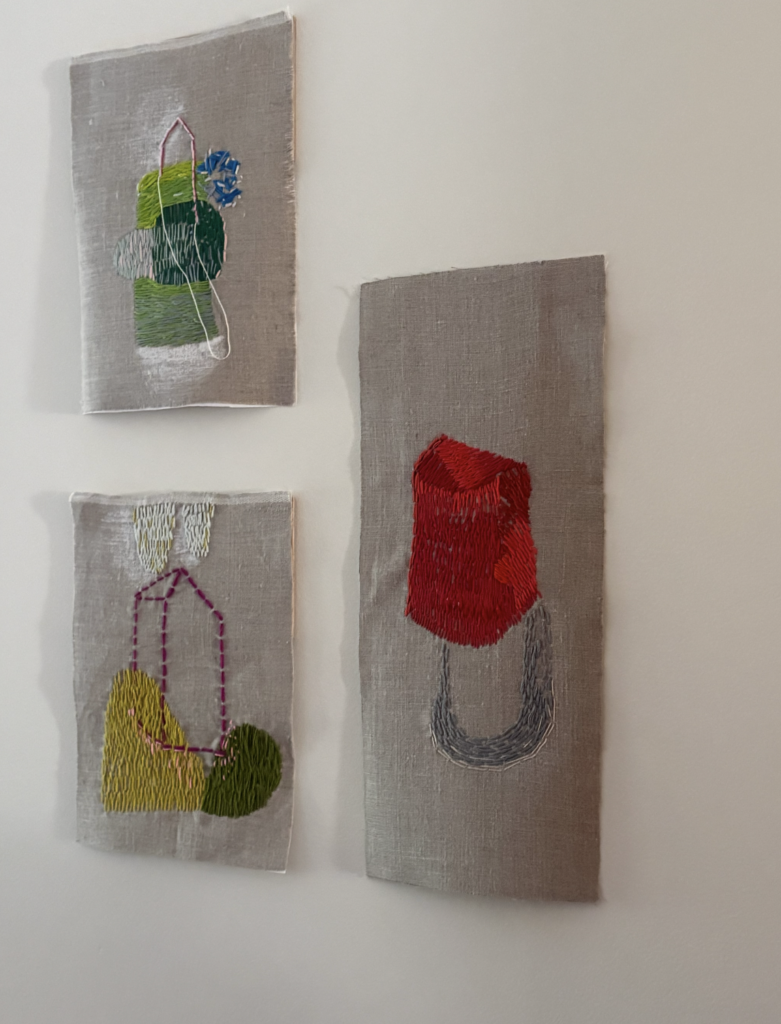
Inside, fiber sculptures hung from the ceiling. Woven illustrations covered the walls. Wooden shelves held baskets, vessels, and objects in different shapes, textures, and colors. Then a large work table — the place where, after a guided tour through the walls and corners of her extraordinary apartment, we sat for a deeper conversation.
Maria’s home studio is not separate from her life. It is her story, her language, and her passion gathered into one intimate space.
Each piece feels like a page from a personal storybook. This is also how she seems to understand her art: as a visual record of her days, her encounters, and perhaps her life. Her works do not simply occupy the room. They narrate it.
“Textile Sculpture Artist Is What Best Describes Me”
Maria hesitates when asked how her work should be defined.
She does not feel comfortable using the word “designer.” The question makes her pause. She inhales, exhales, and then says with clarity:
“I believe textile sculpture artist is what best describes me.”
That phrase opens the conversation.
For Maria Pratas, shaping forms with fiber is not only a technique. It is her preferred way of telling stories. It also carries her heritage, as her grandfather was an artist and artisan himself.
She believes each person carries a personal vocabulary, and hers is made of textiles, color, texture, and form.
Her work becomes a kind of visual inner conversation: a dialogue she maintains with herself and with the world around her every day.
Fiber as a Personal Vocabulary
In Maria’s practice, textile is the medium, but intuition is the engine.
A thought becomes a visual piece through the movement of her hands, the pressure of the material, and the selection of color. Her hands and mind seem to work as one, shaping fibers until an inner message finds its form.
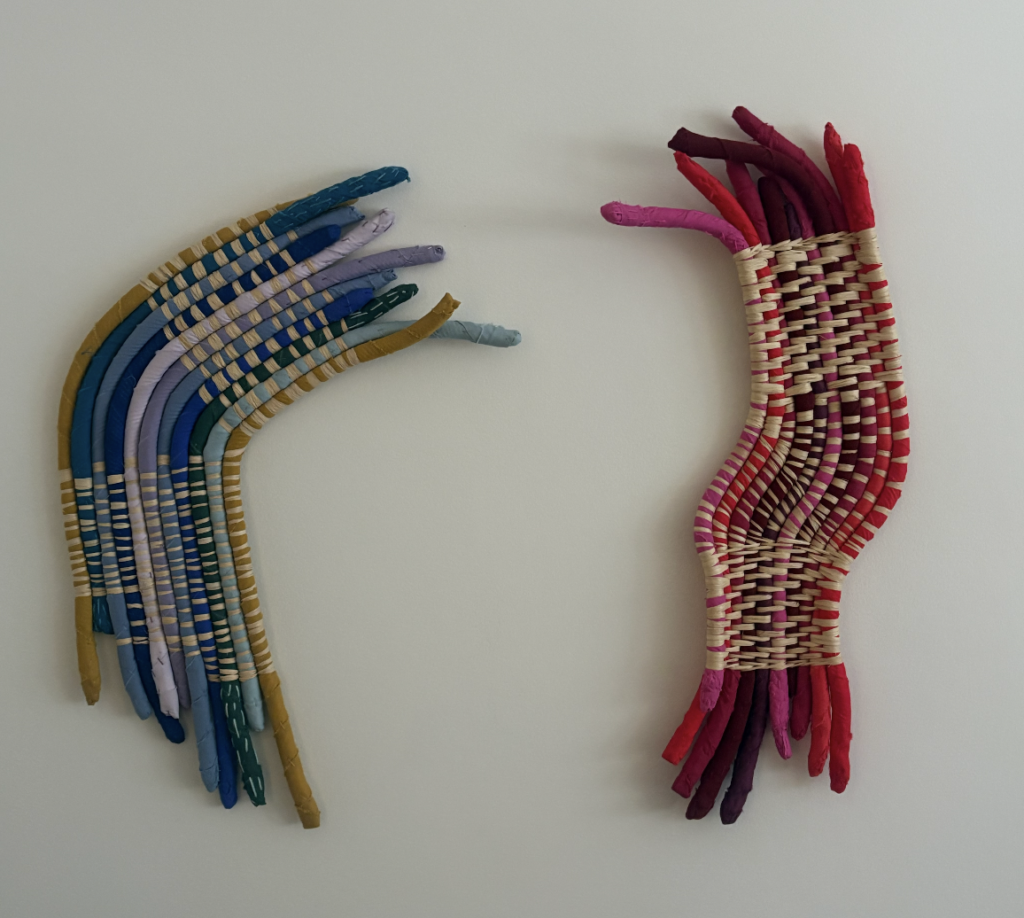
There is no sense of excess in her work. Even when the pieces are abundant, they feel necessary. Each basket, woven postcard, vessel intervention, or suspended sculpture carries the trace of a specific feeling, memory, or encounter.
Maria does not impose meaning on fiber. She listens to it. Then she allows it to become language.
The Role of Intuition in Her Creative Process
Maria speaks about intuition as an essential part of the creative workflow.
For her, making is not a rigid sequence of decisions. It is closer to a conversation. The material suggests, the hand responds, and the work gradually finds its direction.
This is what gives her pieces their emotional precision. They are not overly controlled, yet they are never careless. They carry the looseness of instinct and the discipline of someone who knows her material deeply.
In this sense, Maria’s practice belongs to a wider movement in contemporary craft: one that rejects the division between thought and hand, art and object, intuition and intelligence.
Collaborating Through Fiber and Clay
Maria also believes deeply in collaboration.
These collaborations often happen organically and authentically. She frequently works with ceramic artists, perhaps because clay gives structure to the softness of fiber. The two materials complement one another without losing their individual identities.
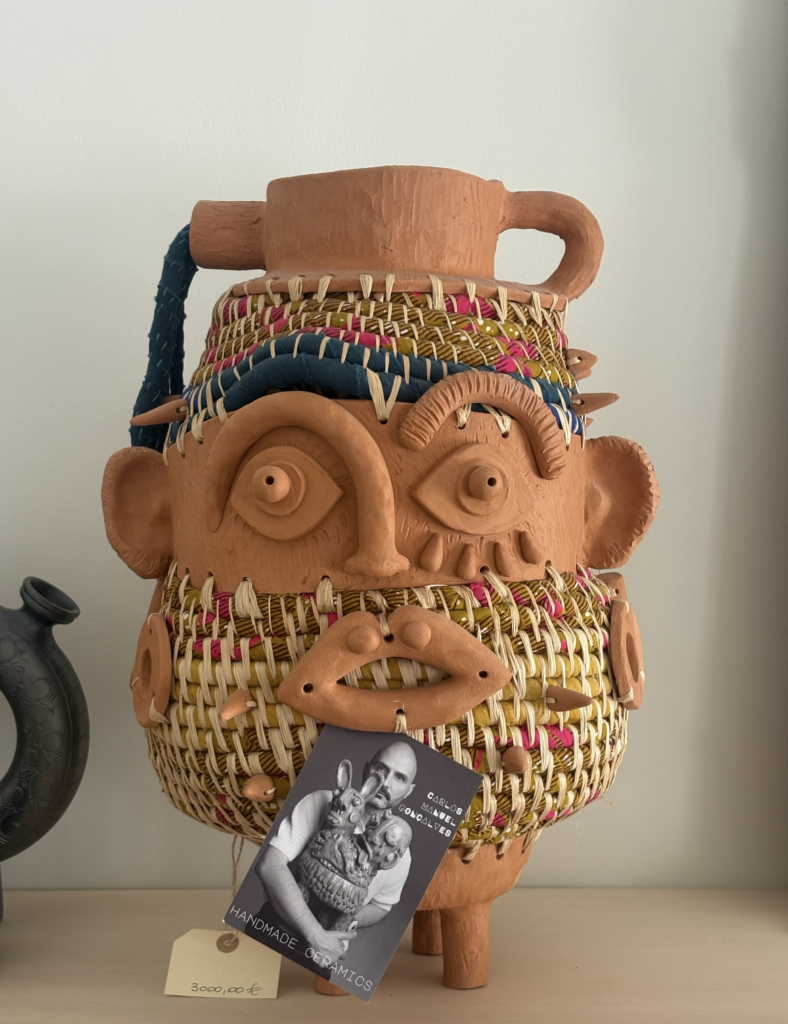
This can be seen in special limited editions, such as the mask vase she co-created with Carlos Gonçalves, and in Saloias, the collection developed with Sofia Albuquerque.
In both cases, the ceramic artists left space for Maria to intervene. That space matters. She does not cover the ceramic object or turn it into something else. She approaches it with openness, listening to its form before completing it with fiber.
Her intervention becomes a dialogue with the vessel.
Maria Pratas, Saloias, and the Intelligence of Handmade Work
With Saloias, Maria Pratas, and Sofia Albuquerque created more than a meeting between textile and ceramics. They built a shared language between softness and weight, rural memory and contemporary form, individual gesture and collective heritage.
Maria’s fiber work carries that same intelligence. It is intimate without being small, rooted in craft without being nostalgic. It speaks through material, but it also speaks to attention — the kind that allows an ordinary object, a vessel, a basket, or a thread to become part of a larger emotional architecture.
Leaving Maria’s studio, it was difficult to separate the artist from the space, the space from the work, or the work from the stories around it.
Perhaps that is the point.
For Maria Pratas, fiber sculpture is not simply what she makes. It is how she remembers, how she observes, and how she gives shape to the invisible vocabulary of her life.


