

A New Independent Language Is Taking Shape
The most interesting visual work in Europe right now is not coming from a single discipline. It is happening in the gaps: between object and image, craft and digital culture, domestic ritual and public space. In 2026, independent practice looks less like a career category than a way of thinking. Designers are making furniture that looks like a sculpture. Ceramicists are thinking like architects. Illustrators are entering the city. Graphic designers are returning to texture, typography, and material presence.
This shift is visible across the European design calendar, from Lisbon Design Week’s expanded 2026 edition, which brings together more than 150 designers across over 80 venues, to Collectible Brussels’ NEW GARDE section, where emerging designers are working with industrial materials, 3D printing, and limited-edition formats.
Product Design: Objects with Memory
Among the strongest names to watch is Lia Raquel Marques, an Angolan-Portuguese designer based in Lisbon. Her work sits at the intersection of product design, textile knowledge and cultural memory. Rather than treating objects as neutral forms, Marques approaches them as cultural artifacts: things that carry ancestry, social histories, and questions of belonging. Her Royal College of Art profile describes a practice grounded in Angola’s cultural and socio-economic landscape, giving her work a depth often missing from contemporary collectible design.
In a different register, Alan Louis brings sculptural force to ceramic furniture. Born in Brittany and working between Lisbon, Paris, and Brittany, Louis uses hand-built clay to create tables, lamps, and objects with an almost architectural weight. His pieces feel less designed than excavated: heavy, quiet, and full of surface tension.
Visualizza questo post su Instagram
Visualizza questo post su Instagram
Textile Design: The Return of the Hand
Textile practice is also gaining renewed importance, especially when it moves beyond decoration. Maria Pratas, a Portuguese textile sculptor and visual artist, is one of the most compelling voices in this space. Her work transforms weaving, basketry, and fiber techniques into three-dimensional forms that speak of landscape, memory, and gesture. She represents a broader European return to slow material intelligence: not nostalgia, but resistance to frictionless visual culture.
This is why textile-led work matters in 2026. As digital images become faster, smoother, and more disposable, fiber offers a different rhythm. It records pressure, time, and the body.
Visualizza questo post su Instagram
Ceramic Art: Mediterranean Color, Postmodern Energy
Ceramics remain one of Europe’s most fertile independent languages. In Italy, Paolo Santangelo and Arianna De Luca are two names Hue & Eye readers should know.
Santangelo, born in Bari in 1990, draws from Puglia, Bauhaus references, fashion, and postmodern design, creating ceramic objects that feel vivid, playful, and resistant to mass production. De Luca, based in Rome, creates collectible ceramic objects shaped by Mediterranean heritage, bold color, and a contemporary decorative intelligence. Her work shows how the domestic object can still carry wit, identity, and visual pleasure without becoming superficial.
Visualizza questo post su Instagram
Visualizza questo post su Instagram
Illustration and Urban Art: The Image Leaves the Page
In illustration and urban art, Camilla Falsini remains a key figure to watch. Her practice moves fluently between editorial illustration, public murals, and large-scale visual storytelling. Based in Rome, she has worked with publishers, brands, and institutions while also participating in street-art festivals and urban art projects.
Falsini’s importance lies in how illustrations as spatial language are treated. Her bold geometries and saturated forms do not merely decorate walls; they reorganize how a passerby reads a place. This is where urban art becomes visual design at the civic scale.
Visualizza questo post su Instagram
Graphic Design: Typography Becomes Atmosphere
Graphic design in 2026 is also becoming more tactile. The most interesting studios are not simply producing logos or layouts; they are building visual systems that move, react, and carry texture. Futur Neue, an independent Geneva-based graphic design, typography, and research group, is a strong example of this more investigative direction. Its work links typography with research, history, and visual systems rather than treating graphic design as surface styling.
In Hamburg, Studio Lucas Hesse works across visual communication, motion, code, and kinetic typography, showing how graphic design is increasingly shaped by movement rather than static composition.
Visualizza questo post su Instagram
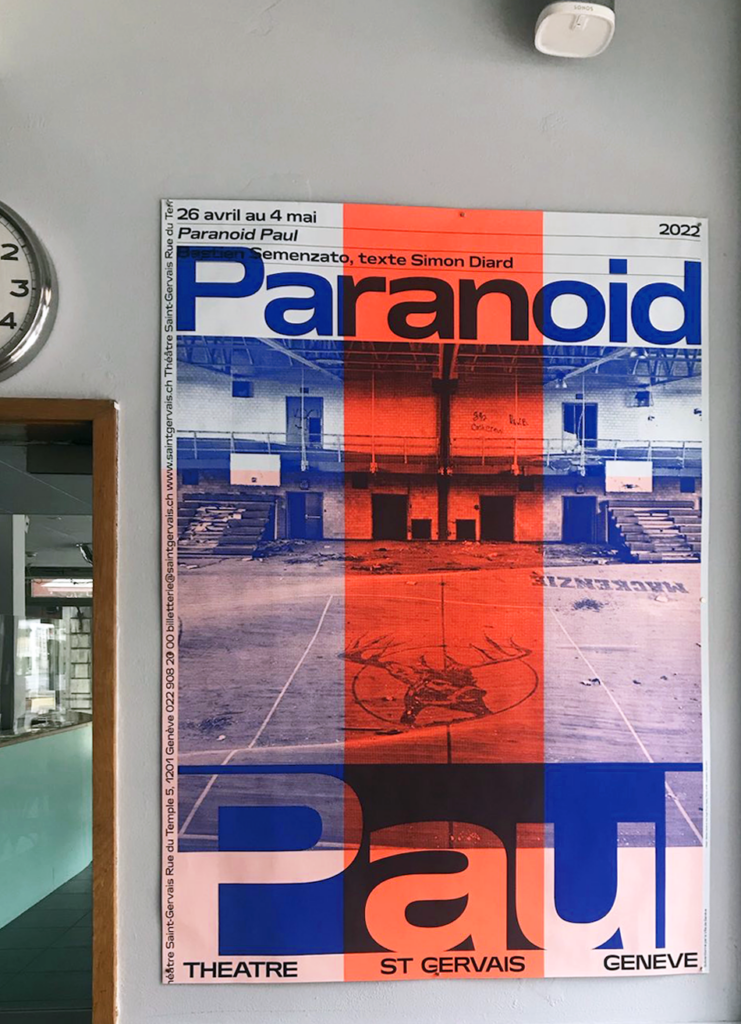
@Futur Neue, Paranoïd Paul
Collaboration with Matteo Venet
Théâtre Saint-Gervais Genève
Poster, 2022
Why These Practices Matter Now
What connects these talents is not style. It is the independence of method. They are not chasing the same smooth international aesthetic. They are using material, place, memory, and image-making to build practices with texture and consequence.
In 2026, the European visual scene to watch is not defined by being glossy. It is defined by pressure: the pressure of the hand on clay, fiber, wall, code, type, and object.

