

Lisbon Design Week 2026 arrives with a sharper question than scale: what can independent design still do that global fairs often cannot? Taking place from May 27 to May 31, 2026, the fourth edition positions Lisbon not as a satellite of larger design capitals, but as a city where craft, material intelligence, and small-scale authorship are becoming central to contemporary visual culture.
As Hue & Eye observed in its 2025 coverage of Lisbon Design Week and independent design trends, the event’s strength has never been only its program. It is the way Lisbon allows design to be encountered through streets, studios, galleries, hotel spaces, workshops, and temporary interiors rather than through a single fairground.
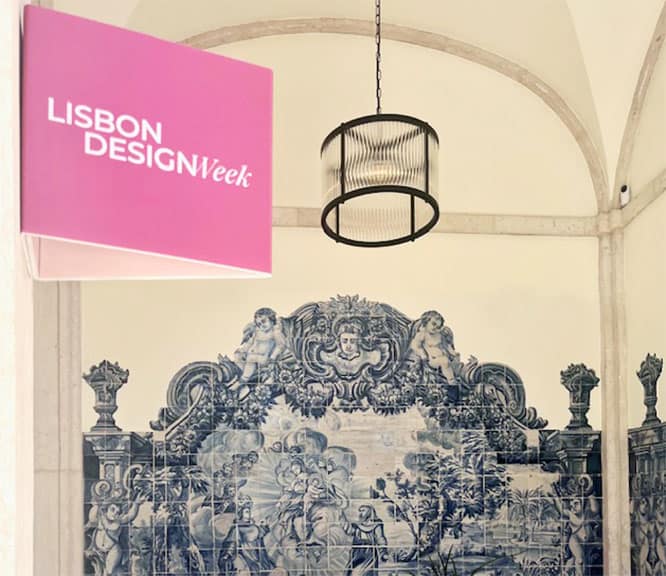
A Citywide Model for Independent Design
The 2026 program is still being revealed progressively, which already says something about the event’s rhythm. Rather than presenting design as a finished market spectacle, Lisbon Design Week works more like a living map: participants, locations, and collaborations unfold across the city.
That citywide logic was already visible in Hue & Eye’s 2025 guide, How To Navigate Lisbon Design Week, where the event expanded across more than 95 venues and 250 creatives.
The lesson for 2026 is clear: independent visual culture is becoming less centralized, more relational, and more dependent on context.
Craft Is No Longer Nostalgia
One of the most compelling directions in the 2026 edition is the continued elevation of craft as a contemporary language.
Maria Pratas and Sofia Albuquerque, listed respectively within textiles and ceramics, suggest a conversation between softness and structure, surface and vessel, domestic memory and experimental form.
Visualizza questo post su Instagram
Carlos Manuel Gonçalves, also listed among the 2026 ceramic designers, extends this attention to clay as a medium of authorship rather than decoration.
His presence points to a broader shift:
Ceramics are no longer appearing at design weeks as lifestyle accessories, but as sculptural, cultural, and spatial propositions.
Hue & Eye readers will recognize this line from previous features on Tosco Studio, MACHEIA, and João Bruno, all of whom helped frame Portuguese design as a field where material practice carries emotional and cultural weight.
Visualizza questo post su Instagram
From Object to Atmosphere
The 2026 program also suggests that independent design is moving beyond the isolated object. Fantastic Frank Lisbon’s presentation of Alan Louis, described as an exhibition of sculptural furniture and objects exploring material and quiet tension within a lived environment, points to a more atmospheric form of display.
This matters. The future of visual culture is not only about what an object looks like, but how it behaves in space.
A chair, vessel, textile, or lamp now has to carry mood, narrative, material ethics, and photographic presence.
Independent design is becoming a way of composing environments.
Visualizza questo post su Instagram
International Dialogues, Local Ground
Ambre Jarno of Maison Intègre brings another important layer. Maison Intègre’s participation connects Lisbon Design Week to craft networks beyond Portugal, while Jarno’s practice bridges Europe and Ouagadougou, where she works close to the studio’s production context.
That international presence does not dilute Lisbon’s identity. It strengthens it. The most interesting design weeks today are not nationalist showcases; they are cultural meeting points where local materials, global routes, and independent studios create new visual vocabularies.
Visualizza questo post su Instagram
Emerging Voices and the Future of Authorship
Lia Raquel Marques appears within the Young Design Generation context, an initiative dedicated to emerging designers and critical reflection. Her inclusion matters because the future of independent design depends on access.
Visualizza questo post su Instagram
As we wrote in Our Highlights from Lisbon Design Week, the value of LDW lies in meeting the people behind the works. In 2026, that intimacy may be the event’s strongest cultural position.
Lisbon Design Week 2026 tells us that independent visual culture is not retreating from the world. It is becoming more precise: slower, more material, more collaborative, and more aware of where things are made. In a design landscape often flattened by speed and sameness, Lisbon’s promise is different. It asks us to look closer.
Read similar articles on Hue&Eye Mag > or stay tuned for more updates on the LDW2026 soon!


