

Nevercrew is among the most recognizable names in contemporary Swiss street art. A long-running duo known for large-scale murals where nature and human-made systems collide—sometimes literally. Based in Switzerland, Christian Rebecchi (Lugano, 1980) and Pablo Togni (Bellinzona, 1979) have worked together since the mid-1990s, developing a visual language that moves fluidly between public walls, installations, and studio works.
Who are Nevercrew?
Nevercrew is a Swiss artist duo formed by Rebecchi and Togni, active together since 1996. Their background includes formal art training in Lugano and later studies at the Accademia di Brera (Milan). This foundation helps explain the strong drawing and painting discipline behind their street-scale compositions.
While many street artists stay within one recognizable “style,” Nevercrew’s practice is broader: mural painting sits alongside installations, sculpture, and smaller-format works—always tied together by a consistent conceptual focus.
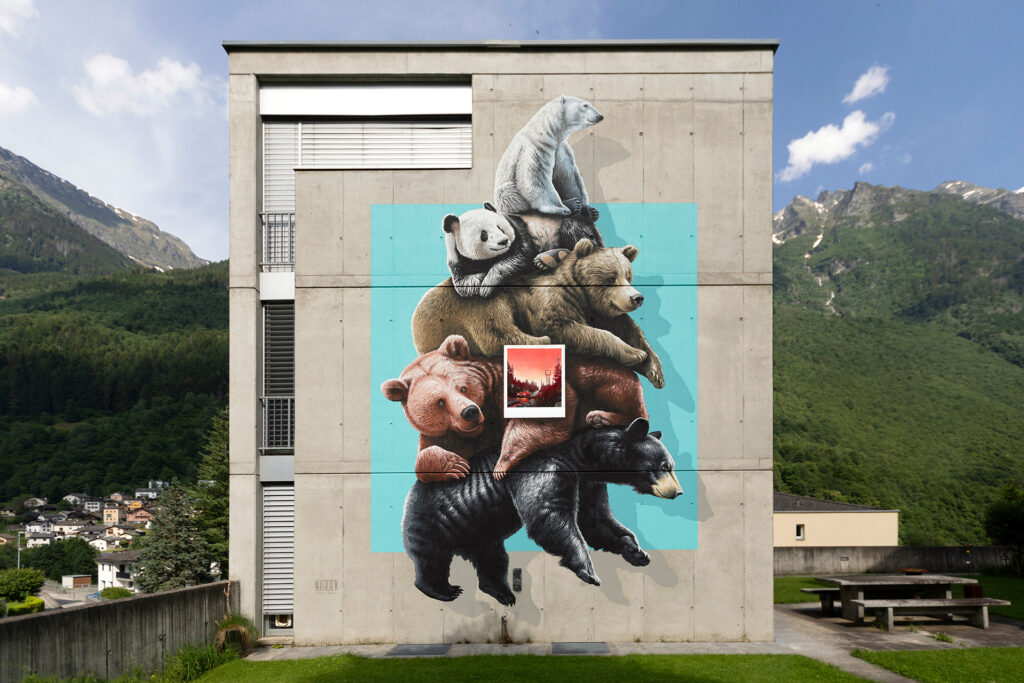
“Lo Zoo di Mesocco” – Series of 13 mural interventions realized along a path that crosses the districts of the Municipality of Mesocco, Switzerland, curated by mMoMAm (Mini Museum of Modern Art Misox). 2024.
A visual signature: nature vs. machine
Nevercrew’s most iconic images often feature animals (especially whales and polar bears) rendered with a near-hyperreal care, then interrupted by geometric frames, schematics, diagrams, or industrial elements. This “double world” creates instant tension: the organic softness of living beings placed inside hard-edged human systems.
Critically, the duo uses contrast not just as an aesthetic device, but as a means of meaning.
Their work has been described as emerging from an analysis of the relationship between humankind and nature, turning public space into a shared stage for ecological and ethical questions.
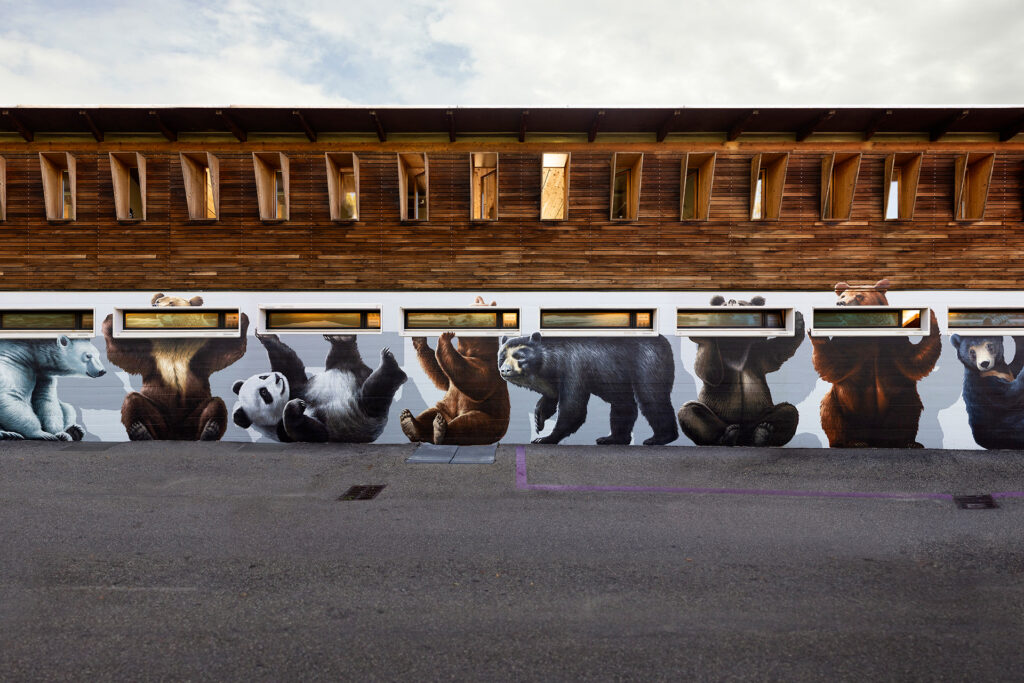
“Echo” – Mural painting with backlit elements realized in Lugano (Switzerland) for Arte Urbana Lugano, in the context of Longlake Festival, 2025.
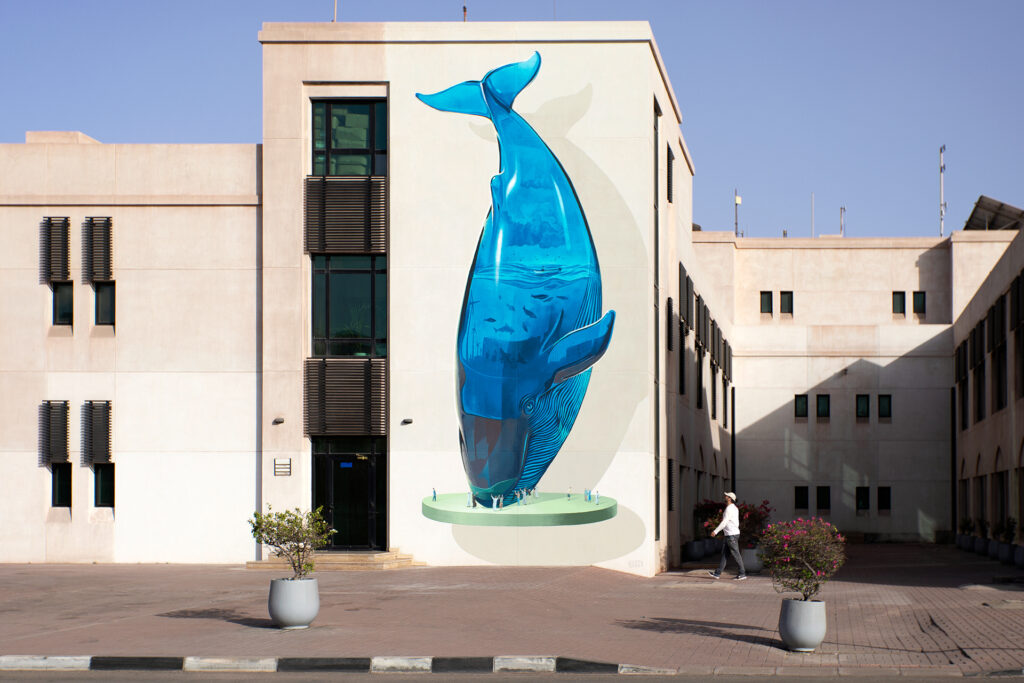
“Pivot” – Mural painting realized in Sohar (Oman) at the Sohar Port and Free Zone, curated by the Embassy of Switzerland to celebrate the Oman Sustainability week, 2025.
Murals as public conversation (not just decoration)
Nevercrew’s murals are “big” in the literal sense—often monumental—but the ambition is also social. Their public works push viewers to notice what is usually background noise: environmental degradation, imbalance, and the quiet consequences of daily choices. NRDC, for example, highlights how its larger-than-life works draw attention to our uneven relationship with nature.
They also treat society and the environment as interconnected systems. In the text accompanying works like Panorama, the duo describe a “unique global balance” made of many interacting systems—and critique how economic policies can distort that perception, distancing humans from nature.
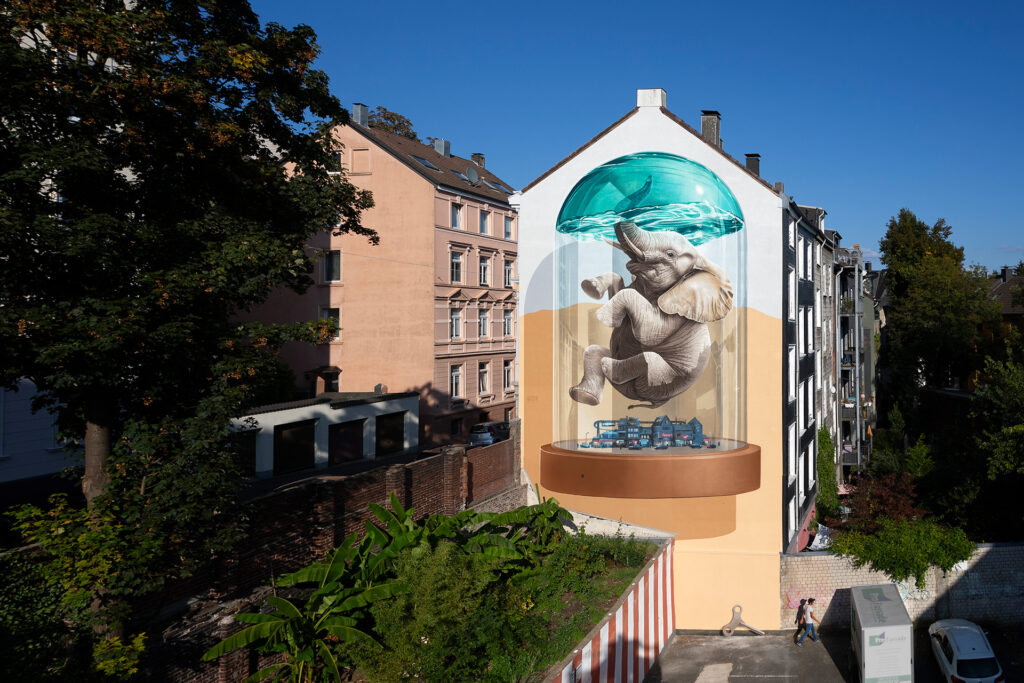
“Switch” – Mural painting realized in Wuppertal (Germany) for Urbaner Kunstraum Wuppertal, curated by Valentina Maoilov, 2024.
Beyond climate: empathy, borders, and the human condition
Although environmental themes are central, Nevercrew’s scope also includes social issues—especially where human behavior reshapes the world. Projects such as Inhuman Barriers explicitly address immigration and integration, questioning the loss of empathy and the rise of psychological or physical “barriers.”
One reason their work resonates internationally is that it is not limited to a single slogan. Instead, they create images that invite viewers to engage and reflect on themes such as impact, responsibility, and the delicate balance between control and care.
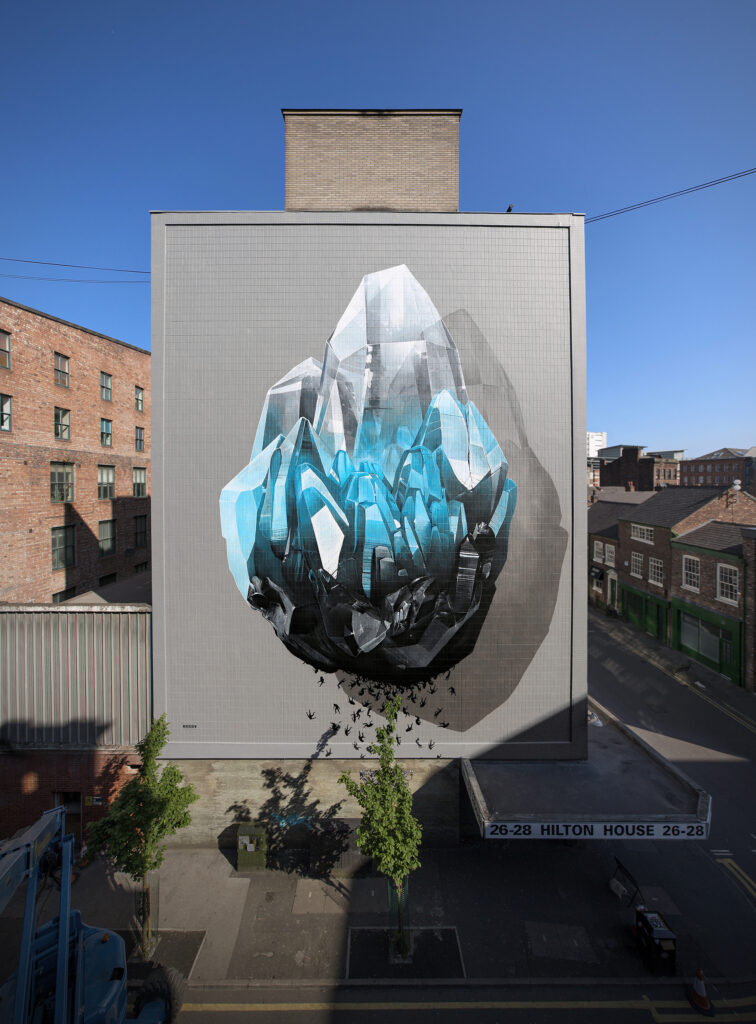
“Inhuman barriers” – Mural painting that addresses the theme of immigration realized for “Cities of hope” in Manchester (UK), in support to the local solidarity group WASP (Women Asylum Seekers Together), 2016.
Why Nevercrew matters in contemporary street art
Nevercrew occupies a compelling position within urban contemporary art: accessible enough to stop passers-by in their tracks, yet layered enough to reward slow reading. They have also been recognized within the broader scene (including mentions of awards and “most influential” lists in urban art contexts).
In a world saturated with images, their murals work like visual “alarms”—not loud, not moralizing, but persistent. A whale trapped in a transparent box. A polar bear intersected by mechanical structures. These are not just striking compositions; they are metaphors for the ways modern life contains, measures, and sometimes endangers what it depends on.
To know more about Nevercrew, go here >
Follow Nevercrew on Instagram >


