

From album covers to The Happy Show, Stefan Sagmeister’s career asks: Can graphic design influence our emotions?
Sagmeister’s work refuses to sit quietly. It scratches, performs, seduces, jokes, confesses, and sometimes makes viewers uncomfortable. His work tests the limits of how far design can move into emotion, psychology, and public experience.
Sagmeister is a useful companion to Paula Scher. Scher makes typography speak like a city; Sagmeister makes it act like a confession. Both expanded the design’s scope, but Sagmeister’s work is more intimate and psychologically exposed.
Born in Austria in 1962, Sagmeister became a leading figure in graphic design by constantly asking a central question: what happens when design stops presenting itself neutrally and instead directly influences how we feel? One vivid example is his album cover for Lou Reed‘s Set the Twilight Reeling, where Sagmeister famously scratched the album’s credits directly into his own skin. This raw gesture transformed the cover into an act of confession, provoking strong emotional responses and showing how design can cross into lived experience. This inquiry runs through his work in album packaging, typography, exhibitions, installations, authorship, and personal experiments and remains pressing in contemporary visual culture.

So, Who Is Stefan Sagmeister?
Stefan Sagmeister is a graphic designer, typographer, artist, and educator based in New York. He founded Sagmeister Inc. in 1993 and built an international reputation through music packaging, cultural commissions, experimental typography, and later large-scale projects around happiness and beauty.
His clients and collaborators have included The Rolling Stones, HBO, the Guggenheim Museum, Talking Heads, David Byrne, Brian Eno, and Lou Reed. But a client list alone does not explain his influence. Sagmeister’s importance lies in the way he made graphic design feel authored: vulnerable, strange, funny, bodily, and emotionally direct.
While some designers build authority through systems, Sagmeister builds it through tension. For example, in his poster for the AIGA lecture series, he asked an assistant to carve the event details directly into his own skin, photographing the result. The initial shock of the image grabs attention, but the underlying ideas about vulnerability, pain, and communication linger. His work demands a second look: first for impact, then for underlying ideas.
Early Career: From Austria to New York
Sagmeister’s path began in Austria, where he showed an early interest in visual culture and design. He later studied in Vienna and New York before working at Leo Burnett’s Hong Kong Design Group and then at Tibor Kalman’s M&Co in New York. In 1993, he established Sagmeister Inc., developing a practice that moved between commercial commissions and self-initiated work.
The connection to Tibor Kalman matters. Kalman’s influence appears in Sagmeister’s resistance to polished emptiness. For Sagmeister, design is more than visual refinement; it carries wit, contradiction, risk, and social observation.

Album Covers and the Design of Sound
The album design suited Sagmeister’s sensibility. Record covers don’t just identify artists; they translate sound, mood, and expectation. His best music work functions as translation, not mere packaging.
For Lou Reed’s Set the Twilight Reeling, Sagmeister used the face as a surface for language, turning portraiture into something closer to psychological mapping. For David Byrne and Brian Eno’s Everything That Happens Will Happen Today, the official project page describes a special edition package with a miniature 3D diorama, booklet, CD, DVD, and sound effects, showing how far packaging could go in becoming an object, scene, and experience.
Typography as Body, Material, and Event
Sagmeister’s typography is rarely just type. It appears carved, written, assembled, performed, or photographed. The letters seem to have lived before reaching the viewer.
Sagmeister’s type is not always clean, scalable, or obedient. It is often awkward, physical, handmade, and temporary. That imperfection gives it force.
In Sagmeister’s work, typography is proof of human presence. The process—time spent, risk taken, material touched—is visible. Physicality gives contrast to today’s often frictionless digital design.
Sagmeister & Walsh: Beauty, Excess, and the Return of Visual Pleasure
In 2012, Jessica Walsh joined Sagmeister, and the studio became Sagmeister & Walsh. Their vivid, highly staged visual language shaped both commercial and self-initiated projects before their partnership ended in 2019.
Their project Beauty, a book and exhibition, challenged modernist suspicion of ornament. Sagmeister’s project page describes it as a multimedia exhibition exploring why we’re drawn to beauty and how beautiful design can be more effective.
Their argument is not simply decoration; it is a belief. For much of twentieth-century design, beauty was seen as less important than function. Sagmeister and Walsh challenged this, insisting beauty shapes behavior, mood, memory, and use. However, their position is not without critics. Many designers today continue to emphasize functionality over ornament, arguing that beauty can distract from clarity and purpose. By placing beauty at the center of their work, Sagmeister and Walsh encourage a broader debate about where design’s true value lies.
The Happy Show: Graphic Design as Psychological Experiment
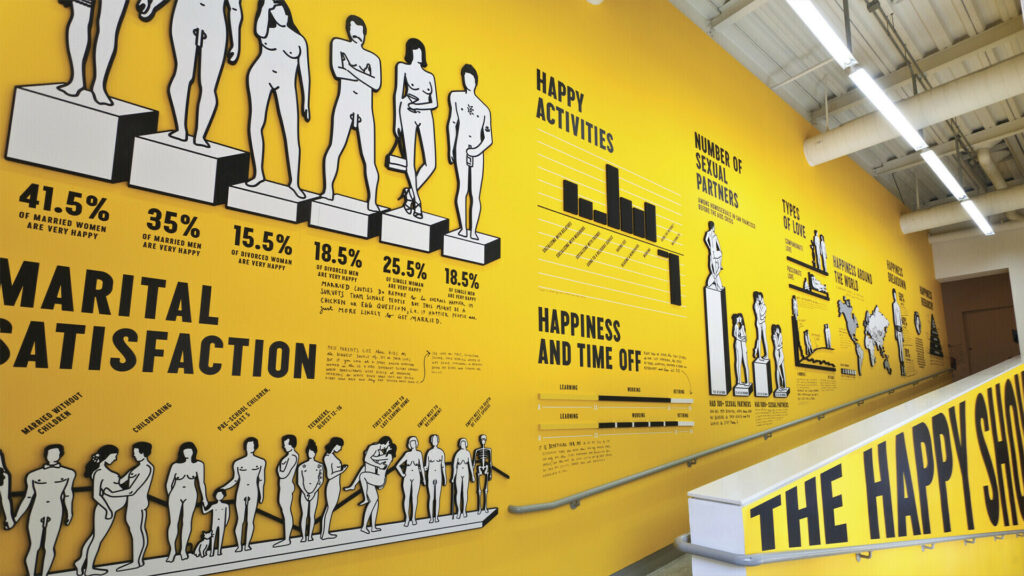
The Happy Show is one of Sagmeister’s most recognizable projects because it turns design into an immersive psychological environment. His official project page describes the exhibition as filling the Institute of Contemporary Art’s second-floor galleries and ramp, allowing visitors to enter Sagmeister’s attempt to increase his happiness through meditation, cognitive therapy, and mood-altering pharmaceuticals.
The exhibition matters because it rejects the idea that design only solves external problems. Here, the designer is both author and subject. Happiness becomes data, an installation, a confession, a joke, and a visual system.
MAAT describes The Happy Show as the result of more than 10 years of research into happiness, featuring video, infographics, sculpture, interactive installations, humor, provocation, and participation.
Beauty, Happiness, and the Problem of Design Optimism
Sagmeister’s later work is debated for its optimism. Projects like The Happy Show, Beauty, Now Is Better, and Beautiful Numbers suggest that design can frame the world more hopefully. His current portfolio features these recent public works. Some supporters argue that his focus on optimism in design is refreshing and necessary at a time when much of visual culture dwells on critique and cynicism. They see his work as an invitation to use design deliberately to inspire joy, connection, and positive change. On the other hand, critics suggest that Sagmeister’s optimistic approach risks oversimplifying complex problems or glossing over the realities of suffering and injustice. They question whether such uplifting messages can truly create change or merely offer momentary comfort. By provoking this debate, Sagmeister’s work remains a lively subject among designers and critics, reflecting ongoing questions about the role and responsibility of design in society.
This optimism is more complex than it first appears. At the heart of Sagmeister’s work is the question: can visual evidence, beauty, public space, and communication truly shift how people perceive the world? This is a vital inquiry, especially during times shaped by anxiety, crisis, and information overload.
The risk is simplification.
Beauty and happiness aren’t neutral; treated lightly, they become slogans.Sagmeister’s best work makes optimism visually challenging enough to examine.
Awards, Recognition, and Influence
Sagmeister’s work has received major recognition. Cooper Hewitt named him the 2005 National Design Award winner for Communication Design, describing him as a major force in design whose work is rooted in entertainment, art, and culture.
SEGD named Sagmeister a 2024 SEGD Fellow and notes his two Grammy Awards for album art: one for the Talking Heads box set Once in a Lifetime in 2005 and another for David Byrne and Brian Eno’s Everything That Happens Will Happen Today in 2010. SEGD also notes his 2013 AIGA Medal and his teaching at the School of Visual Arts.
Awards are important, but Sagmeister’s true legacy is in inspiring designers to treat authorship, emotion, installation, and self-initiated research as central to design practice.
What Designers Can Learn from Stefan Sagmeister
Sagmeister’s provocation only matters when tied to inquiry. For students and emerging designers, this means moving beyond shock value or attention-getting gestures. To make provocation meaningful, start by asking what question your work is really exploring, and use bold visual ideas as a tool to investigate it. Consider identifying a topic you care about, developing a hypothesis, and then experimenting with ways to challenge assumptions or invite deeper reflection. In your own projects, connect any provocative element to a clear intention or line of inquiry. This approach ensures your work doesn’t just stand out, but also sparks real understanding and dialogue.
His work offers several useful principles for contemporary designers:
Design can be personal without becoming self-indulgent.
Typography can be physical as well as digital.
Beauty is not the enemy of function.
Exhibition design can expand graphic design into space.
Self-initiated projects can define a career as powerfully as client work.
A strong visual language often comes from asking uncomfortable questions.
Typography can be physical as well as digital.
Beauty is not the enemy of function.
Exhibition design can expand graphic design into space.
Self-initiated projects can define a career as powerfully as client work.
A strong visual language often comes from asking uncomfortable questions.
Why Stefan Sagmeister Still Matters
Sagmeister widened the emotional range of graphic design, showing it can be intimate, theatrical, and strange without losing intelligence.
In a visual culture increasingly shaped by templates, brand systems, and automation, Sagmeister’s work continually reasserts his main argument: design is not just a service discipline but an act of authorship, experimentation, and cultural inquiry—capable of changing how we feel, not just what we see.
His legacy is not simply that he shocked people. It is what he made graphic design feel capable of touching subjects that many designers avoided: happiness, beauty, discomfort, vanity, optimism, mortality, and the unstable relationship between how things look and how people feel.
Sagmeister remains essential because he doesn’t offer design as a neutral solution, but as an experience.


