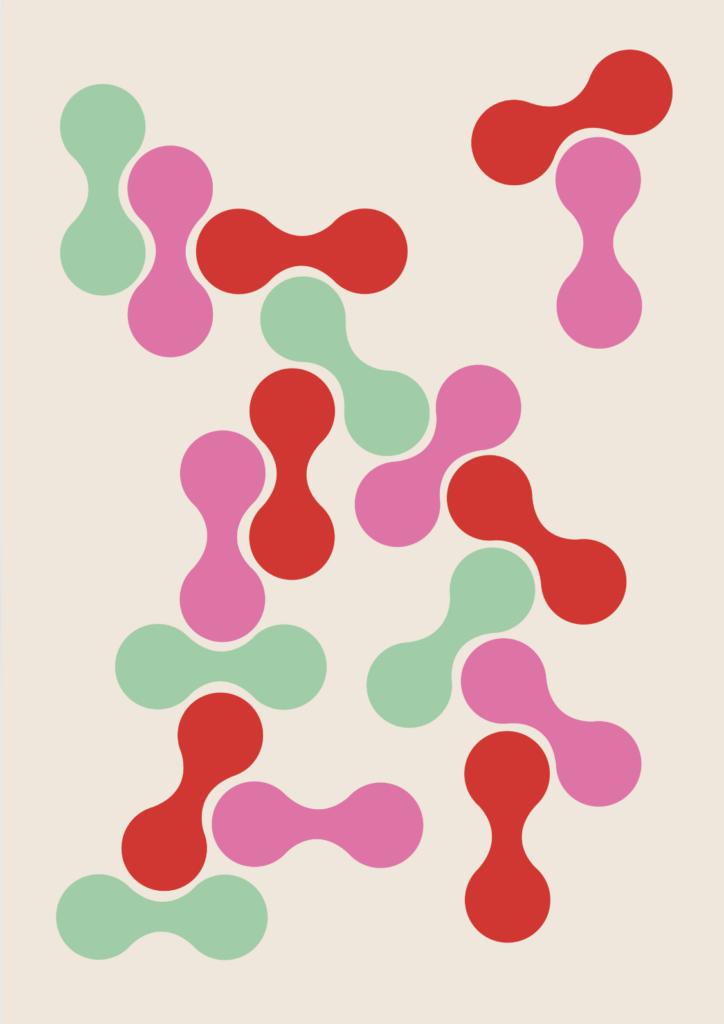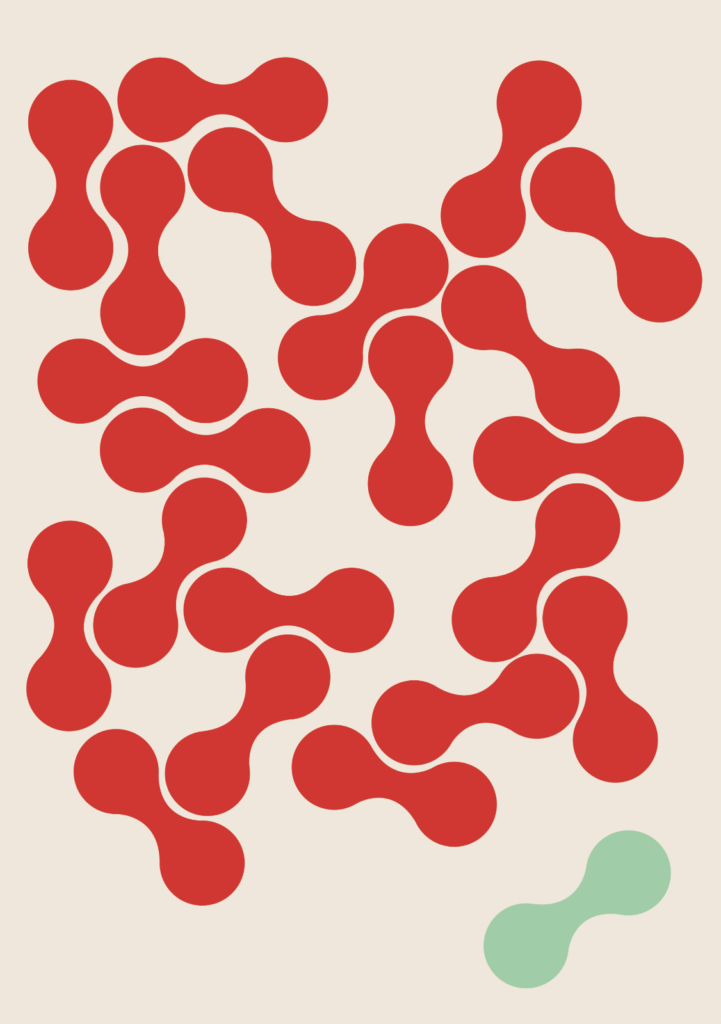


Some objects announce themselves as design, while others wait for touch and visual appeal to reveal their purpose. Olimpia Zagnoli‘s Isolotto, presented at Cantiere Galli in Rome, falls into the second category.
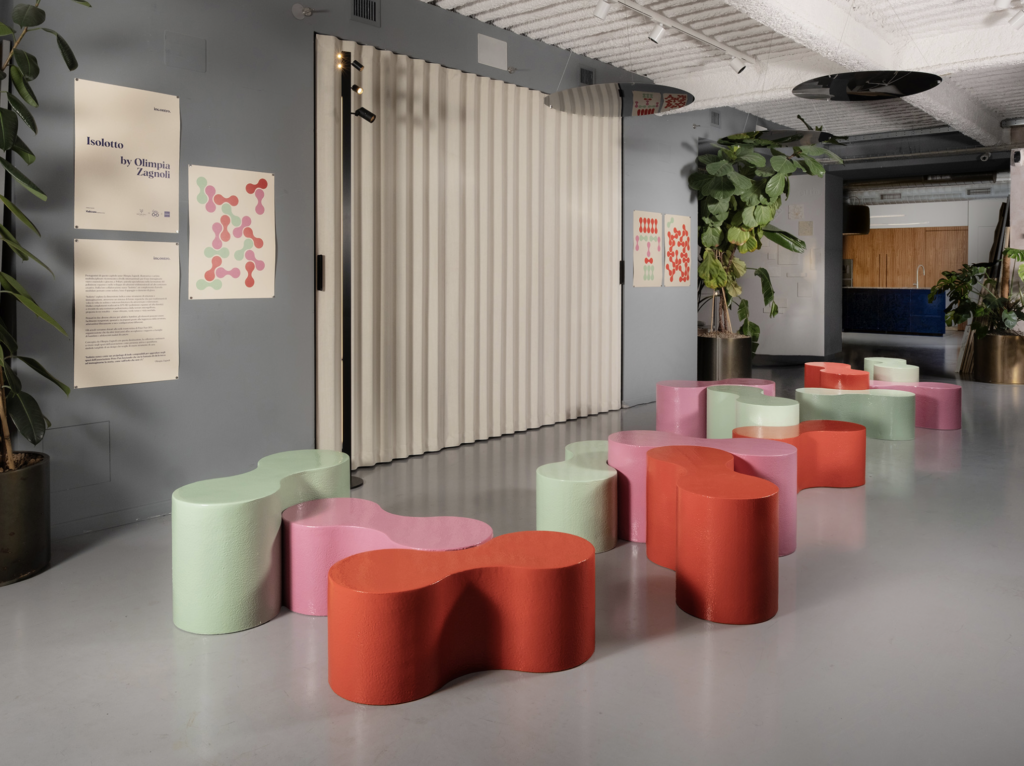
Zagnoli collaborated with Poliart to create the Isolotto, a project that takes the form of a modular archipelago: light, rounded, movable elements that can serve as seats, supports, play structures, or small landscapes. It offers furniture, but not in the conventional sense. It invites users to interact with it rather than merely admire it from a distance.
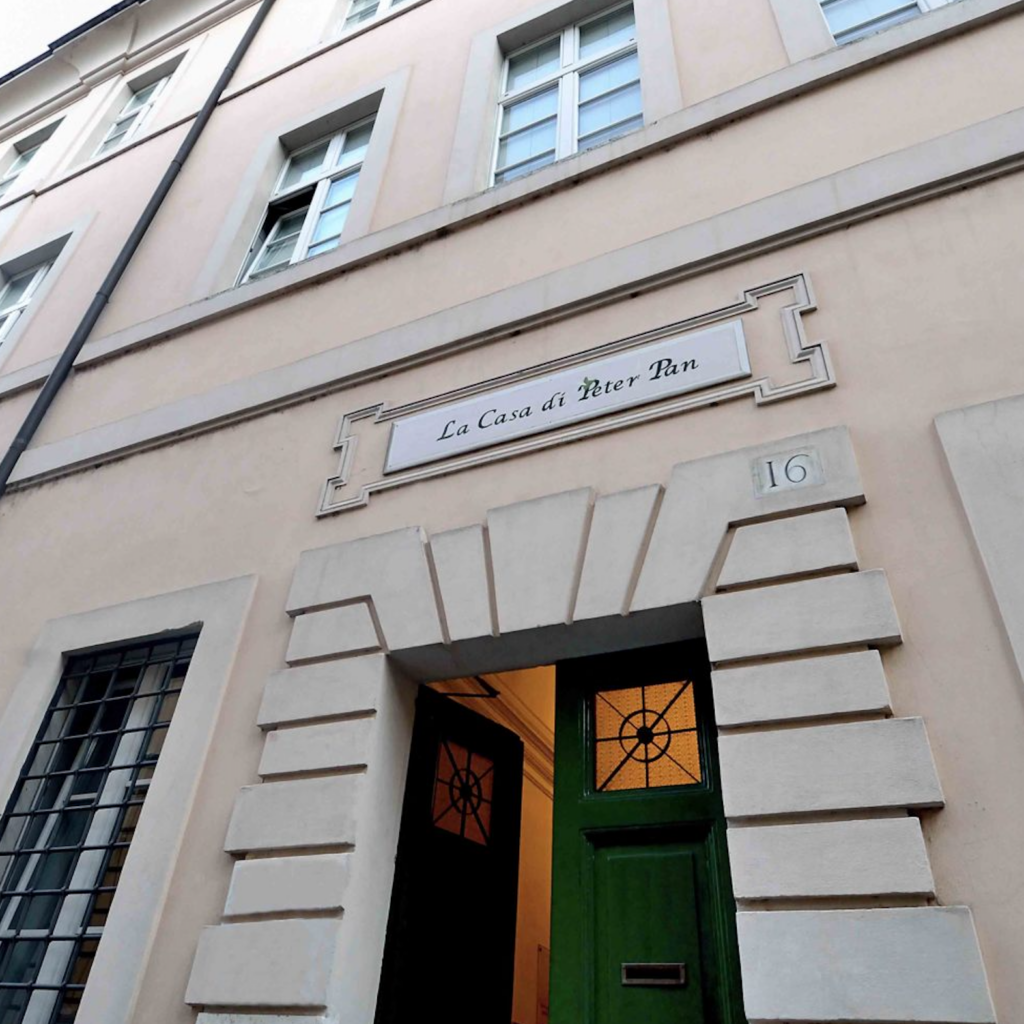
The project presentation event took place as part of Incontro, Cantiere Galli Design’s format that connects designers, companies, cultural actors, and social realities. In this fourth appointment, Zagnoli’s unmistakable graphic language met Poliart’s technical expertise in expanded polystyrene. Isolotto is a donation for Peter Pan ODV, a Rome-based organization that provides free support and services to children and adolescents with cancer and their families.
A Small Island Against Static Design
The title Isolotto (little island in Italian) carries significance. It suggests not just an island but a place that resembles Peter Pan’s Neverland: a sheltered place where time stands still, and adult responsibilities do not exist. Zagnoli describes the project as “an archipelago of modular islands” designed for Peter Pan’s spaces, where imagination will complete the work. Hence, play is at the core of Isolotto.
In much contemporary design, modularity acts as a market feature—adaptable, stackable, and efficient. Here, modularity evokes emotion. The elements don’t exhibit flexibility merely because flexibility sells; they embody it because the users need spaces that can adapt with mood, age, energy, and circumstance.
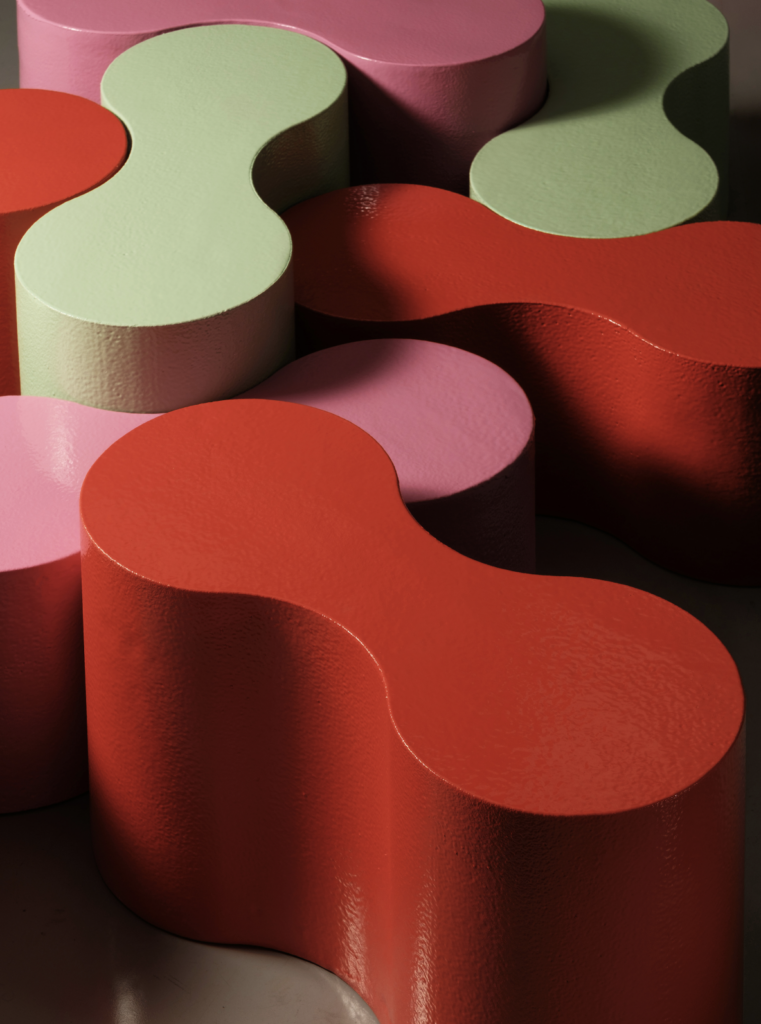
The collection consists of 12 elements crafted from high-density EPS, finished with polyurethane resin and micro-embossed texture. The surfaces showcase three tones—vivid red, soft green, and muted violet—and the pieces come in two different heights for adults and children.
Isolotto introduces a form of design intelligence that operates on a tangible rather than decorative level. It recognizes that a child’s environment isn’t neutral; it can either stimulate the body to passivity or invite movement, choice, and play.
Zagnoli’s Language, Expanded Into Space
Olimpia Zagnoli’s work often reaches for soft shapes, bold colors, and a visual approach that makes complexity instantly understandable. Her practice bridges illustration, installation, publishing, product design, and public-facing visual culture. She holds collaborations across books, editorial work, exhibitions, and spatial projects.
With Isolotto, that language moves beyond flat surfaces and becomes a social tool. The rounded forms maintain consistency with Zagnoli’s graphic universe, but they transform its use. A child can sit on them, and an adult can lean on them. People can reorganize rooms around them.
Their meaning remains fluid as their arrangement never becomes final.
This flexibility resists the decorative trap that often ensnares artist-designed furniture. Isolotto embodies a visual language made usable.
Poliart and the Intelligence of Lightness
Poliart specializes in expanding polystyrene processing and developing three-dimensional creative solutions, placing lightness at the heart of the project’s logic.
Lightness, in this context, becomes ethical. A heavy object dictates how a space behaves, while a light object allows people to navigate the room freely.
This principle holds significant importance at Peter Pan ODV, where families experience vulnerabilities during treatment, travel, and temporary displacement. The association provides free accommodations and support to children and adolescents with cancer and their families receiving care in Rome.
In such a setting, Isolotto can evade the stiffness of institutional furniture, seamlessly integrating into daily life without becoming solemn. It can move, touch, gather, and separate, making spaces feel less like waiting areas and more like places of inhabitation.
The Seriousness of Play
People often consider play as the opposite of care. However, Isolotto suggests the opposite.
In Zagnoli’s project, play serves not merely as entertainment but as a function itself. The object shines because it empowers a child to invent uses rather than follow prescribed ones. It does not dictate posture or narrative; it invites beginnings.
This connection to Peter Pan becomes more than symbolic. The project targets an organization whose name already conjures an imaginary geography: flight, refuge, childhood, the refusal of ordinary limits. Yet, Isolotto does not romanticize illness or childhood. Instead, it offers a practical proposition: rooms can become kinder when their objects foster creativity.
Good social design does not announce its virtue.