

Camilla Falsini and the Rise of Public Illustration in European Cities
Illustration no longer belongs only to books, posters, magazines, or screens. Increasingly, it is moving into the city itself. It appears on walls, pavements, school entrances, crossings, and temporary squares. It does not simply decorate public space. At its best, it changes how people notice, cross, and remember a place.
Camilla Falsini is one of the clearest figures in this shift. The Rome-based artist and illustrator has built a visual language of sharp lines, symbolic figures, geometric rhythm, and saturated color. Her work moves easily from editorial illustration to murals and large-scale urban projects. Yet it keeps its precision when it grows.
That is why her public work feels important now. Falsini shows how illustration can leave the page without losing its intelligence. In her hands, public illustration becomes civic, playful, and readable from a distance.
Visualizza questo post su Instagram
How Illustration Is Entering Public Space
Across Europe, cities are using visual interventions to rethink how people move and gather. Murals, painted pavements, and graphic surfaces now appear in places once treated as purely functional: traffic islands, school streets, underpasses, and pedestrian zones.
This is part of a wider conversation about placemaking and policy limits. A painted square can make a neglected corner more visible, yet it cannot replace housing policy, safety, maintenance, or long-term planning. A mural can become a landmark. A graphic pavement can turn a passageway into a place where people pause.
However, public illustration has a different force from traditional public art. It often begins with communication, knowing how to simplify a message without making it empty. It can turn a complex story into a figure, a pattern, a symbol, or a color system.
As a result, it speaks quickly. Children understand it. Commuters register it in motion. Residents begin to use it as a point of orientation. People who may never enter a gallery still live with it every day.
Visualizza questo post su Instagram
Camilla Falsini’s Graphic Language
Camilla Falsini’s public illustration works because it is direct without becoming generic. Her forms are bold but not blunt. Her figures often suggest masks, animals, myths, alphabets, maps, and invented creatures. They feel ancient and contemporary at the same time.
This balance matters in the city. Public space is visually crowded. An artwork competes with traffic, signage, shopfronts, weather, and movement. To survive there, an image must be legible. It must hold attention quickly.
Falsini’s work does that through strong contrast, clear shapes, and a controlled use of color. Nothing feels accidental. Even when the forms are playful, they are built with discipline.
Her language also avoids the coldness of corporate graphics. It has the immediacy of design, but it keeps the strangeness of illustration. That tension gives her urban projects their character.
From Mural to Civic Surface
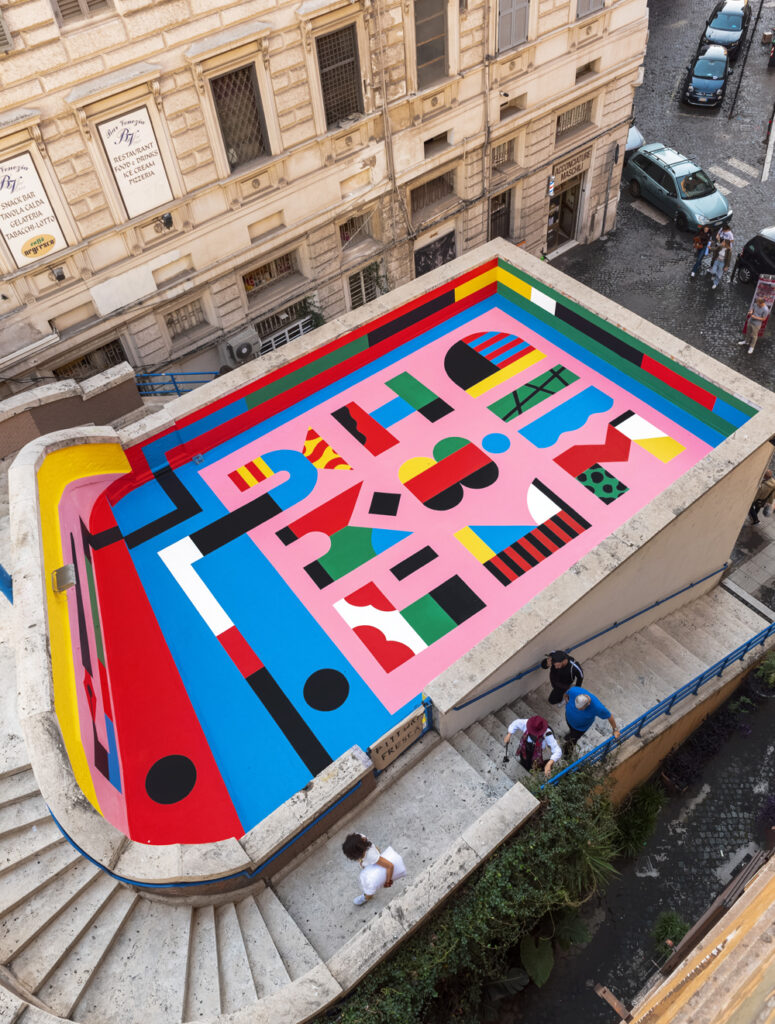
The most interesting part of Falsini’s practice is the move beyond the vertical mural. Public illustration is no longer only something to look at from the street. It is becoming something people stand on, cross, and use.
This shift changes the illustrator’s role. The artist is not just producing an image for a surface. She is shaping a shared environment.
Falsini’s work for Milan’s Piazze Aperte made this visible. In projects connected to Isola and Loreto, large painted forms transformed urban ground into fields of signs and color. The city was not treated as a blank background. Instead, the artwork responded to the neighborhood’s social and physical life.
The result was not a picture placed in the city. It became an image part of the city’s daily life.
The Barona Project and the Power of Participation
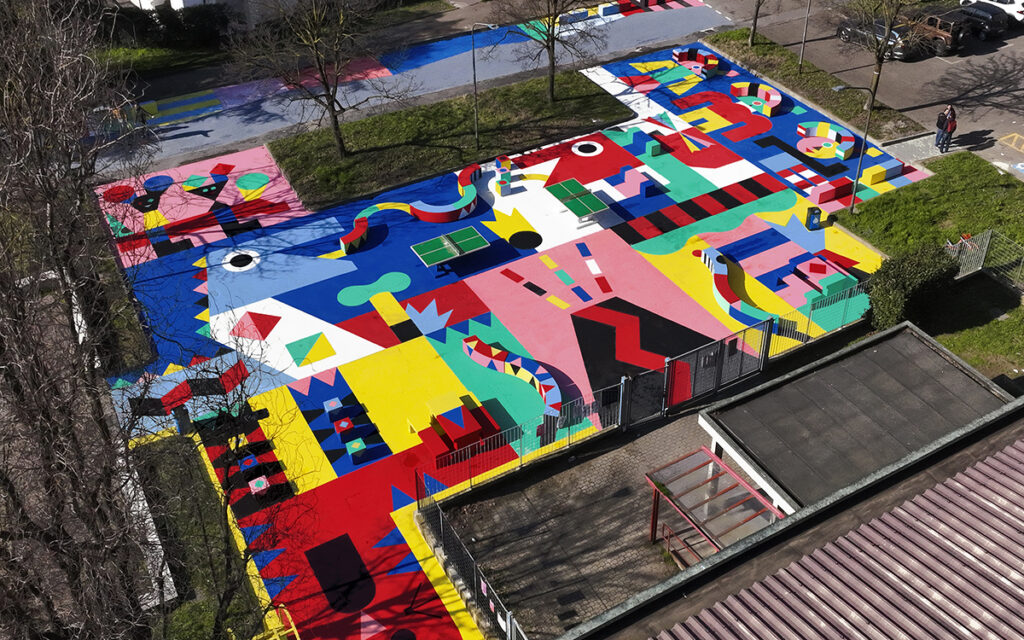
Falsini’s recent work in Milan’s Barona district pushes this idea further. A former parking area near a school was transformed into a colorful pedestrian and play space. The project involved children from the neighborhood, who contributed stories and characters through a workshop process.
This detail is important. Here, illustration does not decorate participation after it happens. It gives participation a visible form.
The children’s imagination becomes part of the square. Their stories enter the public surface. The artwork becomes a place where play, memory, and movement meet.
For this reason, the Barona project is more than a bright urban intervention. It suggests a different model for public illustration. The illustrator becomes a translator between local stories and shared space.
Why Public Illustration Matters Now
Cities need more than efficient movement. They also need signs of care, identity, and imagination. Public illustration can help create those signs.
Of course, color alone cannot solve urban problems. A painted square does not replace housing policy, safety, maintenance, or long-term planning. It cannot repair a city on its own, and it remains limited by the same civic constraints it seeks to soften.
Yet it can shift attention, by making a neglected place feel seen. It can invite people to slow down, by helping residents recognize their neighborhood in a new way.
This is the graphic turn in public space. Cities are adopting the language of illustration because it is accessible, flexible, and emotionally clear, while still working within policy limits. When done well, it does not turn the city into a backdrop for images. It makes images part of civic life.
Visualizza questo post su Instagram
Camilla Falsini and the City as a Shared Page
Camilla Falsini’s work shows why public illustration is becoming so relevant. Illustration can remain intelligent while reaching a wide audience, or be playful without becoming naïve. It can be bold without shouting. In this way, it points to a city where images do more than decorate space: they help shape how people move, meet, and remember.
Most importantly, it changes the scale of illustration. The page becomes a pavement. The figure becomes a meeting point. The color system becomes a way to read the city. The city itself starts to feel like a shared page, open to use, memory, and attention.
Falsini’s public projects remind us that visual culture is not confined to galleries, books, or screens. Sometimes, it begins under our feet, and from there, it helps define how a city is seen and lived in.

