

A Lisbon Design Week encounter with Maria Pratas and Sofia Albuquerque. Translating Portuguese heritage into a contemporary language of material, memory, and care.
Every year, Lisbon Design Week offers more than a route through objects. At its best, it becomes a way of reading Portuguese heritage through material intelligence: clay, fiber, wood, gesture, silence, and the stubborn knowledge carried by hands.
At Hue & Eye, we met many makers during the week — artists and designers reshaping traditional Portuguese techniques without reducing them to nostalgia. Yet our encounter with Maria Pratas and Sofia Albuquerque marked a different register. It moved us from observation into intimacy.
Their project, Saloias, is not simply a collaboration between textile and ceramic art. It is a shared language between two women, two materials, and two ways of remembering.
Meeting Maria Pratas: Fiber as a Way of Seeing
We arrived early, not yet aware that the morning would unfold into a world where fiber and ceramics could speak so fluently to one another. There was anticipation on the way there, but also a kind of openness: the feeling that something quiet and exact was waiting to be found.
We first met Maria Pratas, who welcomed us into her home studio to show us her large-scale works. Very quickly, it became clear that textile art is not only something Maria makes. It is something she lives with.
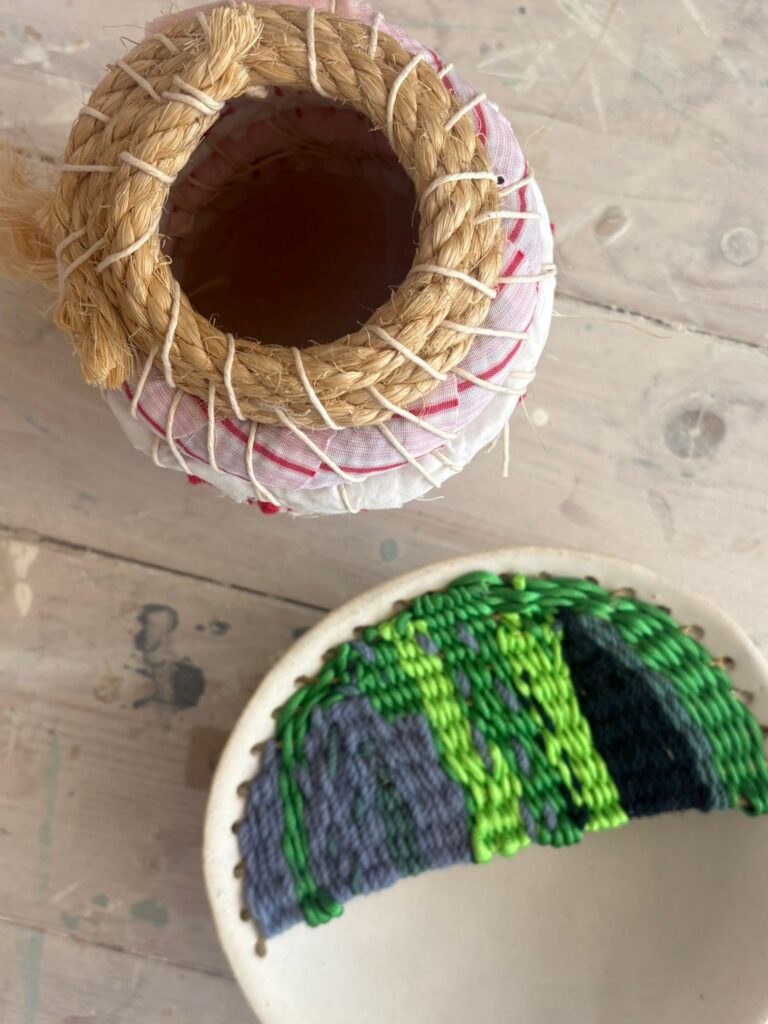
Her work was present everywhere: in the living room, in the bedroom, outside, on walls, in corners, in objects that seemed to hold both patience and movement. Textiles and fibers are part of Maria’s daily grammar. The way she handles texture, color, volume, and technique — whether through a vase, a basket, or a woven postcard — reveals a practice built from attention.
Her home felt like an open book. Each wall carried a page. Each piece held a place, a walk, a collaboration, a memory.
At one point, Maria recalled being in the mountains and weaving a small postcard of a house on a hill. In another work, she completed a ceramic piece by another designer through her own fiber intervention. These gestures reveal the essence of her practice: collecting impressions from the world and translating them into tactile form.
Nothing in Maria’s work feels decorative in the empty sense of the word. Her fiber pieces carry evidence of experience. They are not only made by hand; they are made by looking.
Sofia Albuquerque and the Slow Intelligence of Clay
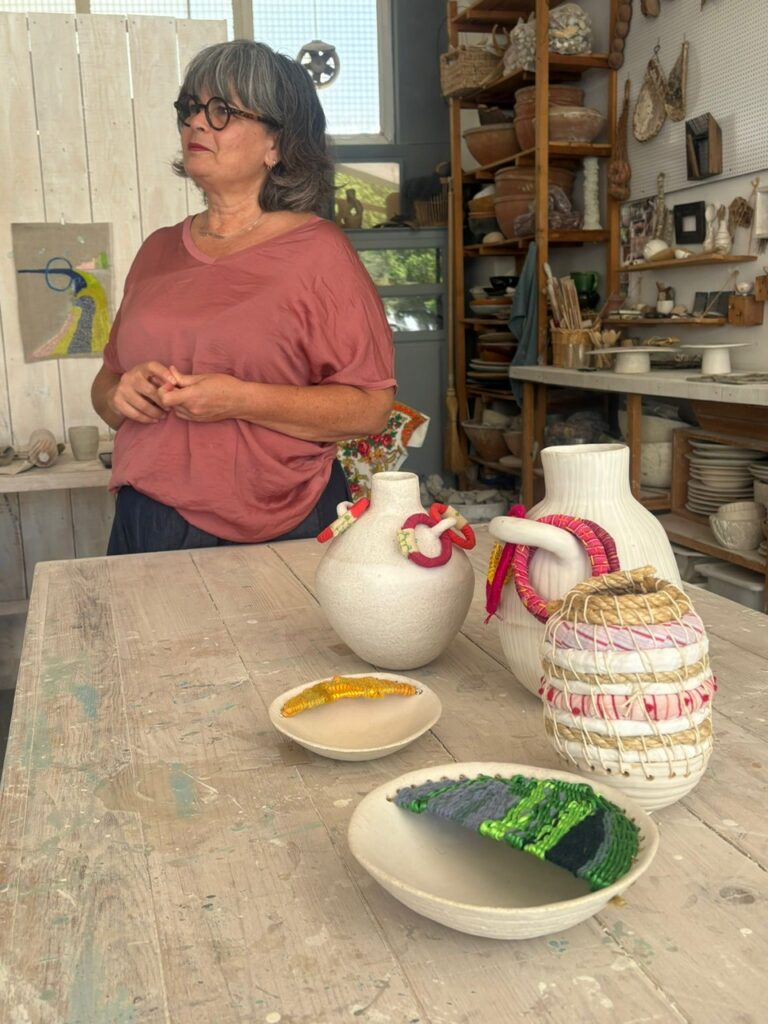
A few meters away from Maria’s home is Sal Atelier, the space of ceramic artist Sofia Albuquerque. It was on this same street that Maria and Sofia first met, working close to one another as neighbors before becoming collaborators.
Sofia’s relationship with ceramics feels almost mystical, but never vague. Her pieces emerge from a dialogue with clay — one based on touch, instinct, slowness, and feeling. She speaks of clay not as a passive material, but as something to be listened to.
Her work belongs to nature’s rhythms: irregular, patient, organic, and alive. At Sal Atelier, ceramics are not treated as polished design objects alone. They become vessels of presence. The space itself feels like a quiet corner of Lisbon built to honor earth, texture, and the emotional weight of handmade forms.
Sofia’s ceramics carry a meditative quality. They ask for a slower gaze. They do not perform loudly; they remain, absorb, and hold.
Maria Pratas Sofia Albuquerque: The Birth of Saloias
When Maria Pratas and Sofia Albuquerque brought their two worlds together, the connection felt immediate: fiber and clay, softness and structure, gesture and vessel, domestic memory and rural strength.
From that meeting, Saloias was born.
The word saloias is the feminine plural of saloio, a Portuguese term historically associated with the rural inhabitants and culture of the countryside surrounding Lisbon. Depending on context, the word can also carry a colloquial sense of rusticity or lack of refinement. Maria and Sofia reclaim it with care.
For them, Saloias becomes a way of honoring a cultural memory often overlooked or simplified. It is not a costume, not a folkloric quotation, and not a nostalgic return. It is a translation.
Saloias brings rural Portuguese heritage into a contemporary language of material contrast: the softness of fiber against the density of clay, the severity of rural life against the tenderness of poetic form, the functional object transformed into a vessel of memory.
Fiber, Clay, and the Gesture of Carrying
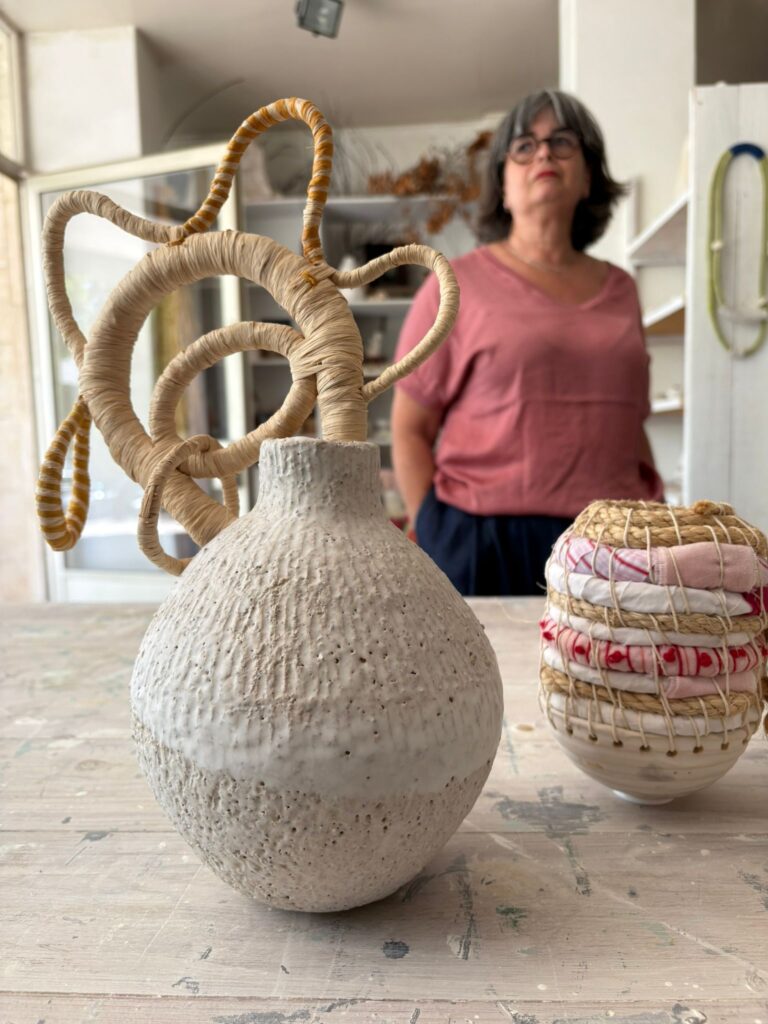
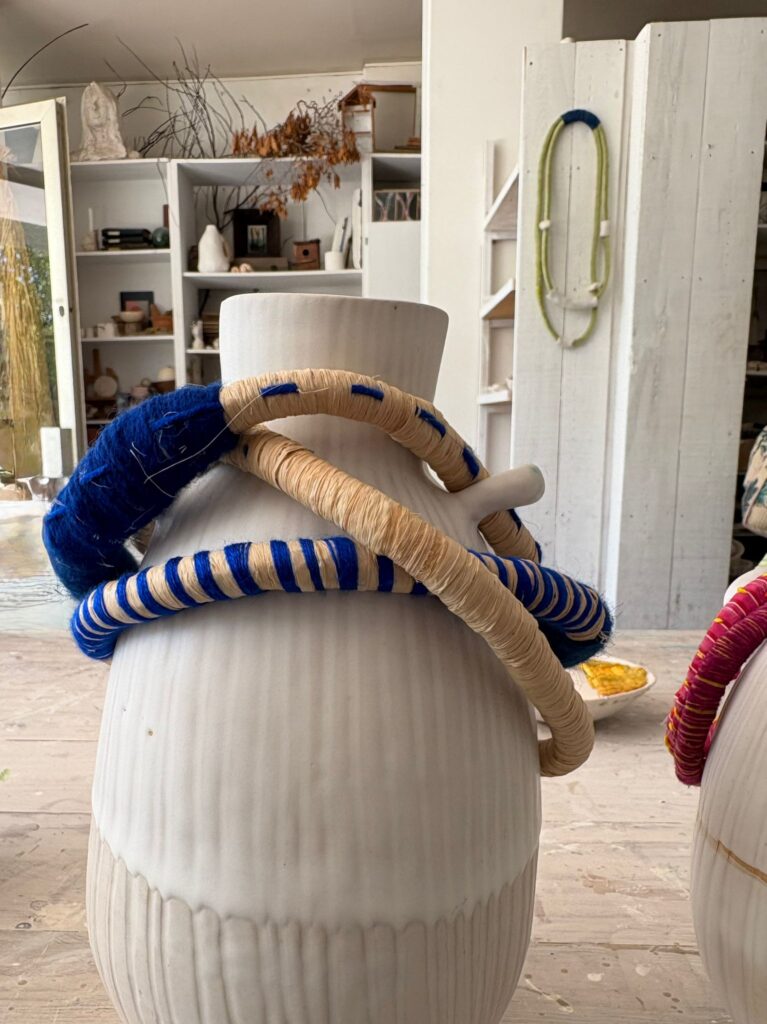
Inside the atelier, small and medium-sized unglazed vases occupy the shelves. Sofia begins each ceramic form while already imagining Maria’s future intervention. Yet she does not dictate it. She leaves space.
That space is essential.
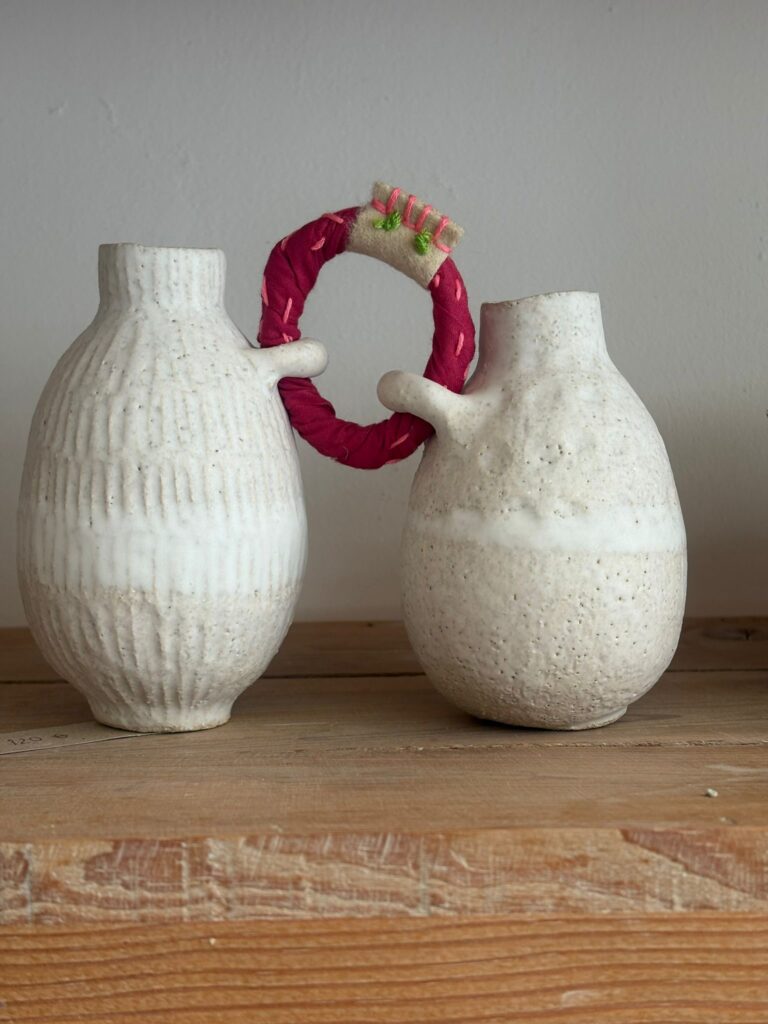
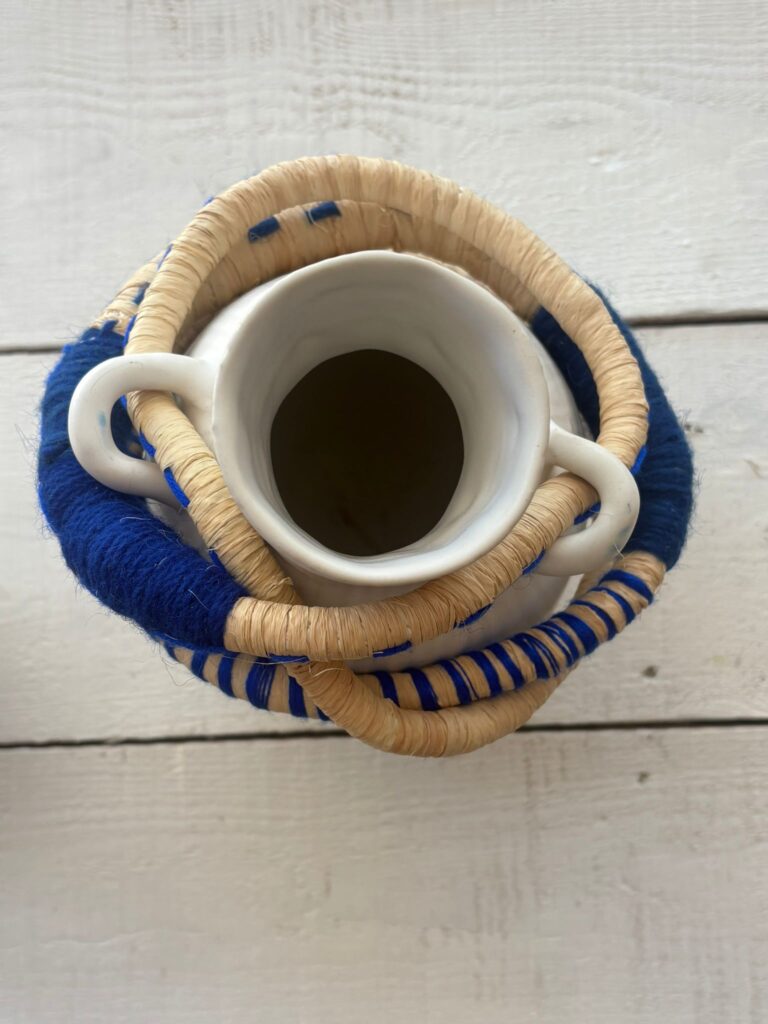
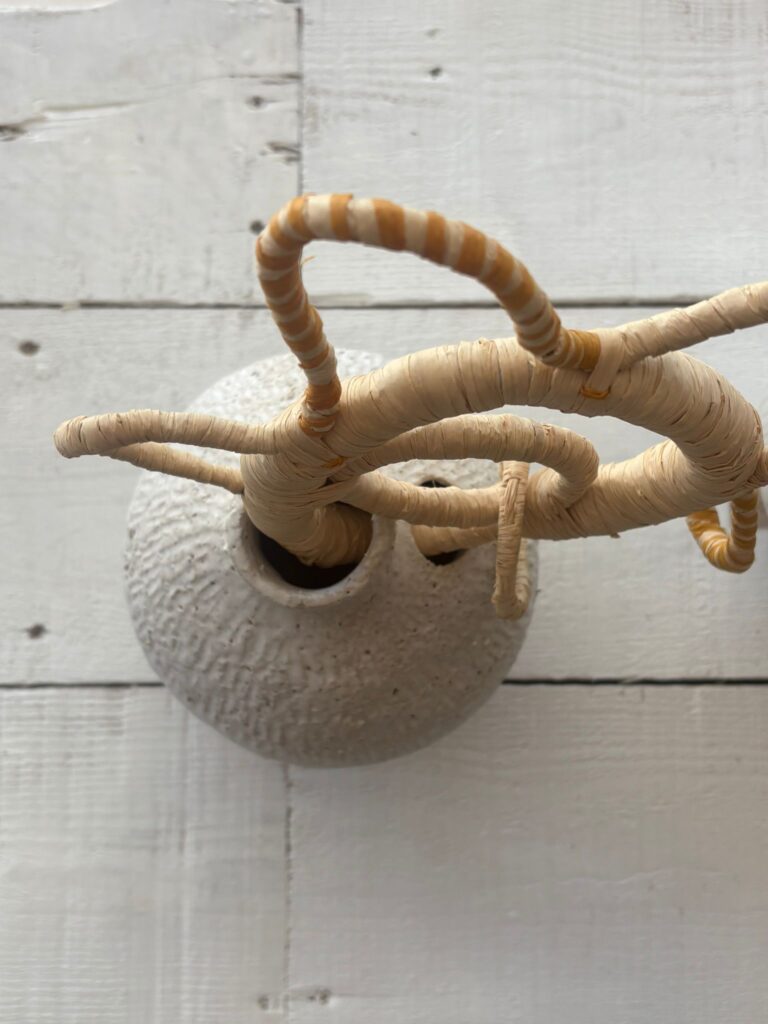
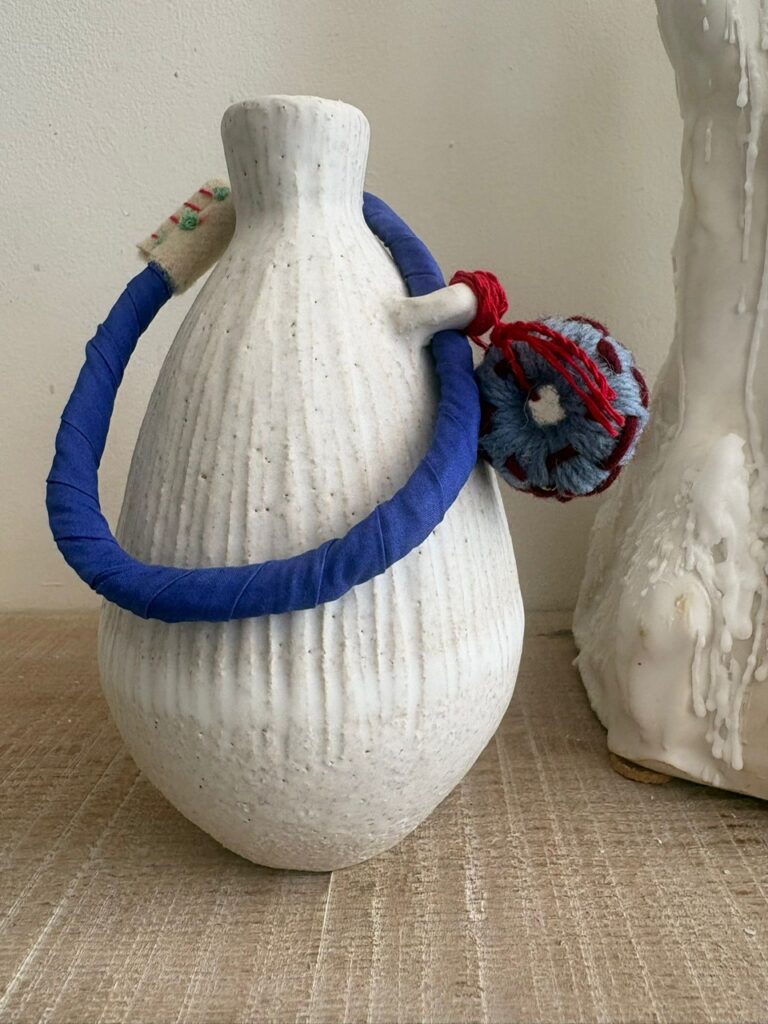
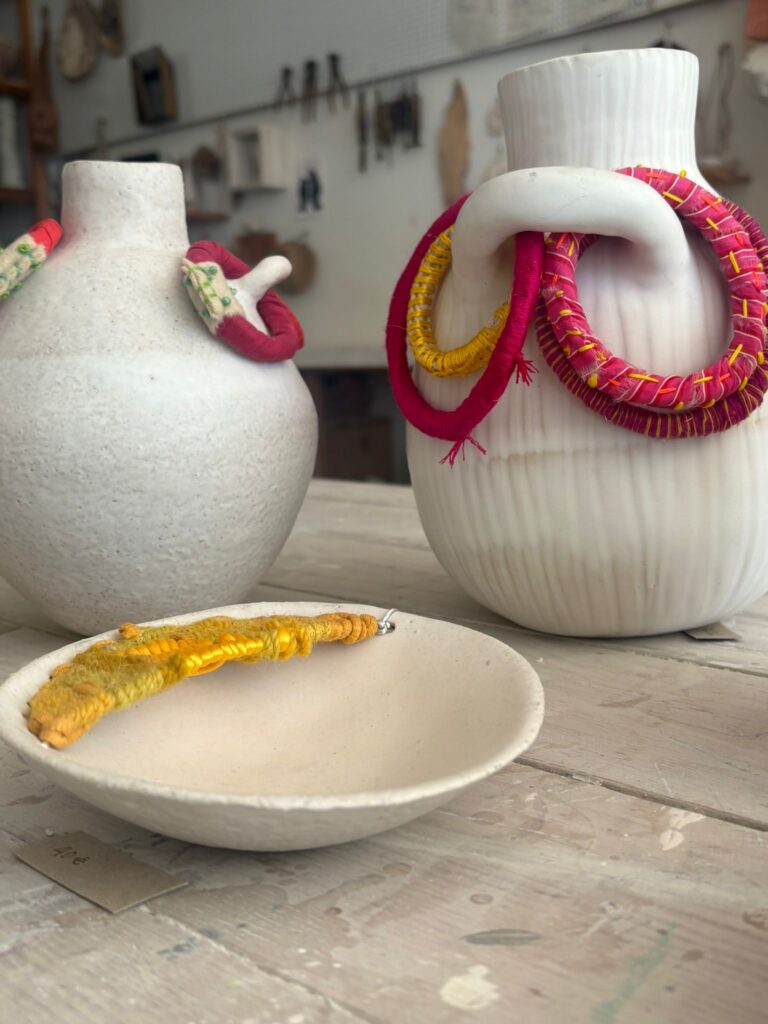
Maria often completes the ceramic pieces with a fiber ring placed around the vessel. The ring refers to the support once used by Saloia women to carry vases and other objects on their heads. In the collection, this reference becomes more than a historical detail. It becomes a gesture of care.
The fiber ring embraces the ceramic body. It softens the vessel without weakening it. It becomes both memory and protection, structure and tenderness, function and symbol.
Here, the collaboration reaches its most powerful form. Sofia’s clay gives weight, silence, and earth. Maria’s fiber adds touch, warmth, and movement. Together, they create objects that feel ancient without being old-fashioned, contemporary without being detached from their roots.
A Shared Language, Not a Simple Collaboration
What makes Saloias compelling is not only the meeting of two materials. It is the ethical intelligence of the collaboration.
Sofia begins, but leaves room. Maria intervenes, but does not dominate. The final object holds both hands without erasing either. This balance is rare. Many collaborations end up as either a fusion or a compromise. Saloias feels more like a conversation.
There is also a powerful feminine dimension in the work: not as a slogan, but as lived knowledge. The collection evokes women who carried weight, sustained domestic and rural life, and shaped culture through gestures rarely preserved in official histories.
In Saloias, that history is not illustrated. It is held.
Why Saloias Matters Now
At a moment when design is often flattened by speed, polish, and market-ready aesthetics, Saloias insists on another rhythm. It asks what contemporary Portuguese design can become when it listens to craft, rural memory, and the intelligence of materials.
The answer is not nostalgia. It is continuity.
Maria Pratas and Sofia Albuquerque show that heritage need not be frozen to be respected. It can be touched, reworked, carried, and made newly visible.
Saloias is not simply a meeting between fiber and clay. It is the birth of a shared language: one that speaks of Lisbon’s outskirts, women’s gestures, handmade knowledge, and the quiet force of objects made with emotional precision.
In Maria and Sofia’s hands, Portuguese craft becomes neither past nor trend. It becomes present.


