


How the Italian Landscape Inspires Contemporary Ceramic Design
An object can hold a landscape without representing it literally. It can evoke Mediterranean light, the outline of a hill, or the rhythm of architecture through a curve, a glossy surface, or a bold chromatic contrast. In the work of Paolo Santangelo and Arianna De Luca, the Italian landscape is not merely decoration. Instead, it becomes a visual language.
Both designers approach tradition from a contemporary perspective. Ceramics remain closely connected to the earth and to the manual gestures of craftsmanship. Yet their collections give the material a more assertive presence. Forms expand, colors intensify, and objects enter interiors as sculptural elements designed to attract attention.
Illustrated decoration almost entirely disappears from their work. There are no painted landscapes, narrative motifs, or descriptive images applied to the surface. Instead, form, color, and the relationship between solid and empty space build the story. The object does not depict the landscape. It absorbs its character and translates it into volume.
Paolo Santangelo: Geometry, Color and Southern Italian Identity
Born in Bari and trained in Milan across product design, communication, and styling, Paolo Santangelo creates a visual language shaped by the encounter between southern memory and contemporary design culture.
Puglia emerges through saturated colors, bright light, and a sense of formal exuberance. Milan, meanwhile, introduces precision, geometry, and a strong attention to composition.
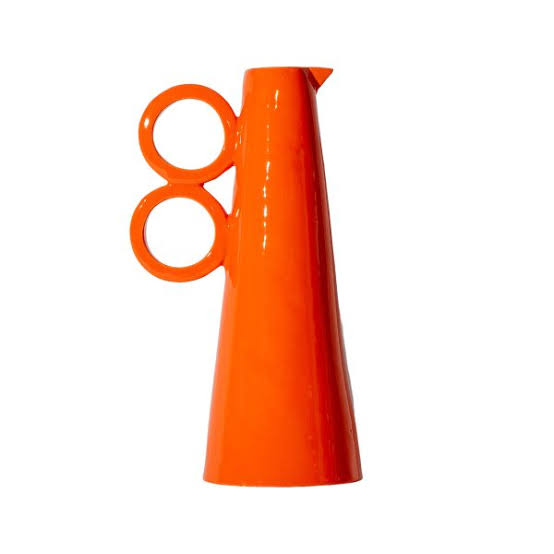
The circle is one of the most recognizable elements in Santangelo’s ceramics. It becomes a handle, an ornament, a structural component, and a graphic sign. It repeats, multiplies, and enriches the silhouettes of jugs, vases, and tableware.
Once enlarged, this elementary shape gains a stronger sculptural presence. The circle is not simply drawn onto the ceramic surface. It becomes part of the object itself.
Color also plays a central role. Yellow, orange, blue, green, and pink do not merely accompany the form. They define it. Clear and saturated tones transform each object into a playful, ironic, and sometimes surreal presence.
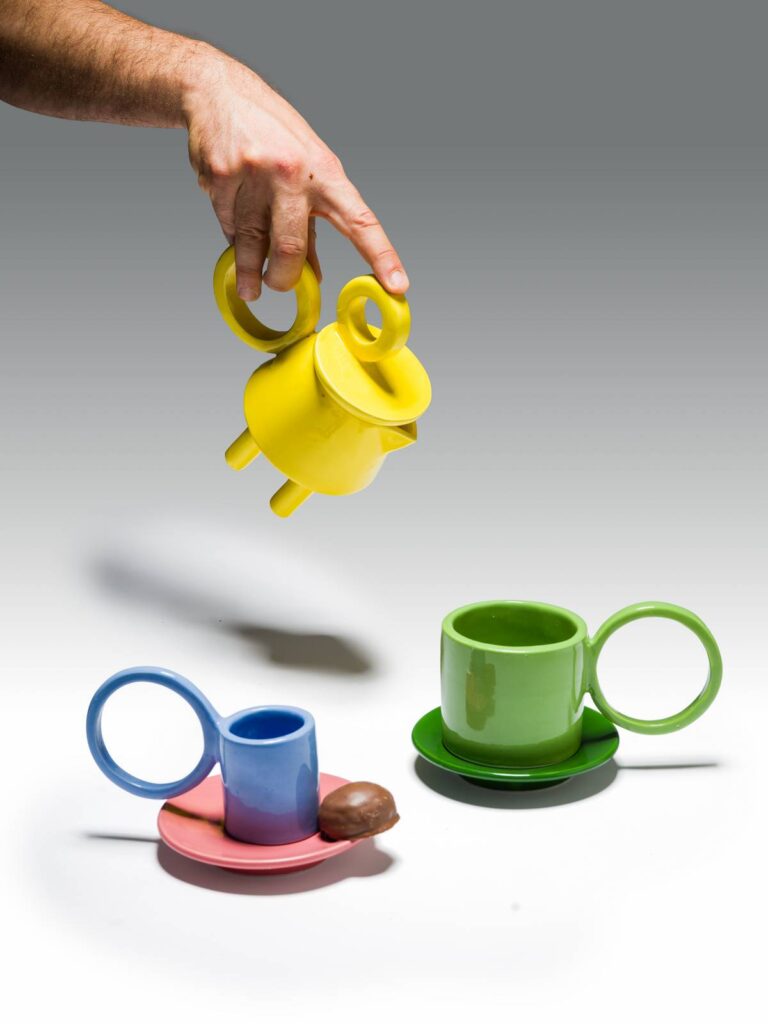
The collections Euclidea and Cartesiana reveal this interest in geometry through their names.
They also articulate a design approach grounded in balance, proportion, and contrast.
Santangelo avoids figurative decoration to concentrate all visual energy within the structure. Color occupies the volume, emphasizes its proportions, and makes the silhouette immediately recognizable.
Arianna De Luca: Mediterranean Memories and Sculptural Ceramics
Arianna De Luca also begins with the landscape in which she grew up. Born in Abruzzo, between hills and sea, she trained in industrial design and completed a master’s degree at Central Saint Martins in London.After working in interior design, she returned to her roots and explored ceramic techniques connected to the tradition of Castelli.Her objects bring back domestic vessels, family rituals, seaside holidays, and fragments of an Italy that seems to belong to another time. The Folcloristica collection, for example, reinterprets the traditional Abruzzese basin, oil cruets, pots once used to prepare tomato sauce, and other archetypes of Mediterranean domestic life.
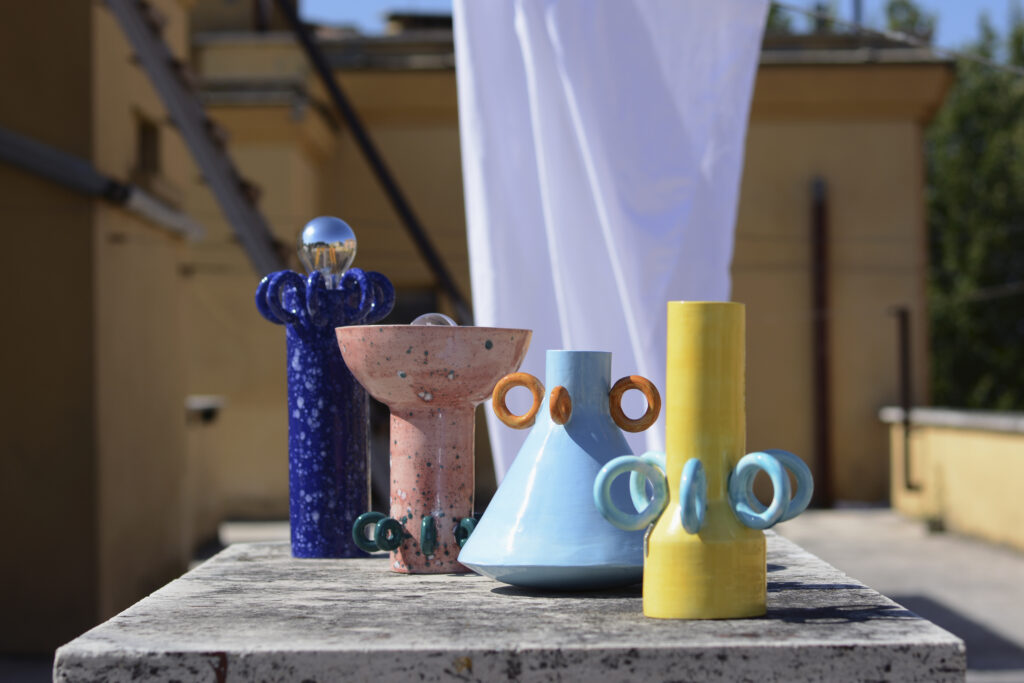
However, nostalgia never becomes melancholy. De Luca translates memory through eccentric palettes of luminous blues, yellows, pinks, and greens, and speckled surfaces.
Her ceramic forms are totemic, solid, and generous. Handles and details often recall eyes, ears, or small bodily gestures. As a result, each vase develops its own personality, almost as if it were an inhabitant of the home.
Her work also moves away from traditional illustrated decoration. Memories do not appear through painted scenes or descriptive motifs. Instead, they live in the outline of a vessel, the scale of a handle, or the unexpected pairing of two colors.
The narrative power comes from the object as a whole, rather than from the ceramic surface treated as a canvas.
Why Color and Form Define the New Italian Ceramics
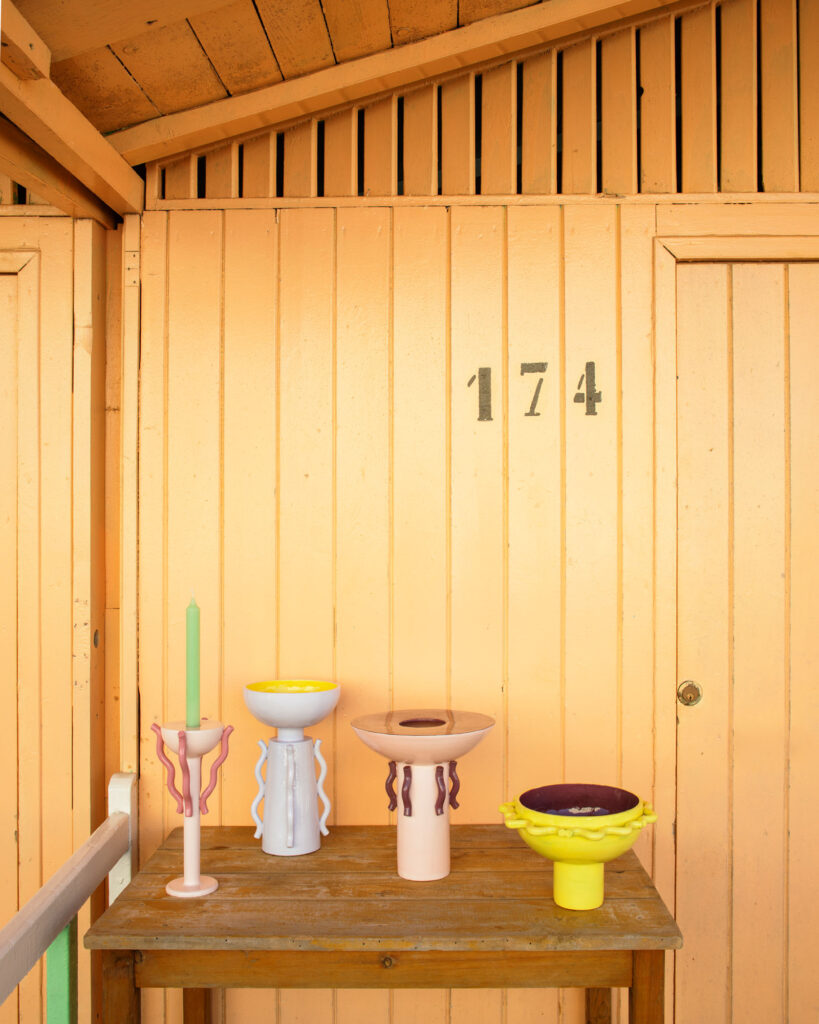
For both Santangelo and De Luca, color is not an accessory. It is a structural element.
It strengthens the silhouette, changes the perception of volume, and gives each object an immediate identity. Bold palettes also distance their work from the neutral tones often associated with minimalist contemporary ceramics.
At the same time, form carries the narrative. Oversized handles, circular elements, totemic bodies, and generous proportions replace traditional surface decoration.
This approach creates objects that feel both functional and sculptural. They can belong to the table or the home, yet they also demand to be observed as independent visual presences.
Their work reflects a broader shift within contemporary Italian ceramics. Tradition remains visible, but it no longer appears through repetition. Instead, it becomes a starting point for experimentation.
When Italian Craftsmanship Meets Digital Storytelling
The new language of Italian ceramics does not emerge only in the workshop. It is also shaped through photography, video, carefully designed sets, and digital storytelling.
Today, creating a compelling object is no longer enough. Designers must also make its world visible and understandable.
For Santangelo, his background in communication and styling becomes an integral part of the project. For De Luca, each collection unfolds within a coherent universe populated by colors, memories, and characters.
In both cases, the image does not replace craftsmanship. It amplifies its voice.
The absence of illustration makes photography even more important. Framing must reveal the profile, scale, curves, and relationships between different elements. Backgrounds, lighting, and color combinations become tools for interpreting the object without overwhelming it.
A carefully composed photograph can emphasize the strength of a silhouette. A video can convey the movement of the hands, the texture of clay, or the brightness of a glaze.
Social media then allows an object created slowly through manual processes to reach galleries, collectors, and international audiences almost instantly.
A New Direction for Contemporary Italian Ceramics
Perhaps the most compelling direction in contemporary Italian ceramics lies in this dialogue between local identity and global visibility.
Paolo Santangelo and Arianna De Luca connect ancient knowledge with new tools, material culture with digital communication, and regional memory with international design.
Their work shows that tradition does not need to remain frozen in place. It can become color, form, narrative, and a living presence within the contemporary domestic landscape.
–


