

Hello Katryna. In your creations, a constant dialogue unfolds between abstract forms and recognizable elements, as familiar shapes take on unexpected meanings. Your artistic language appears to move beyond aesthetics, embracing metaphor, personal reflection, and a more intimate exploration of human emotions. In this sense, your work seems to exist somewhere between what is visible and what is felt. It invites the viewer to discover meanings that are not immediately apparent.
How does this interplay between abstraction and recognition allow you to translate your inner world into a visual language? Do you see your creative process as a form of self-discovery, where each piece reveals something about yourself that words alone might struggle to express?
I have always thought that, for many artists, the creative process is an alternative to language. It is as if we are in a continuous search for other ways to communicate with people, ourselves, and the world.
To me, each form, each shape in my work, is like a particular symbol in a language. Each one is an important part of expressing myself and carries meaning. However, I feel that I am still learning this language, and I will need more time to master it and fully understand what each shape actually represents. That is why, a lot of the time, I allow myself to be silently led by an inner feeling that tells me whether I have said everything that needed to be said through this or that particular piece.
Sometimes, it seems to me as though each work tries to ground me in the world, as if the world were a never-ending book and my object were one very tiny symbol within it.
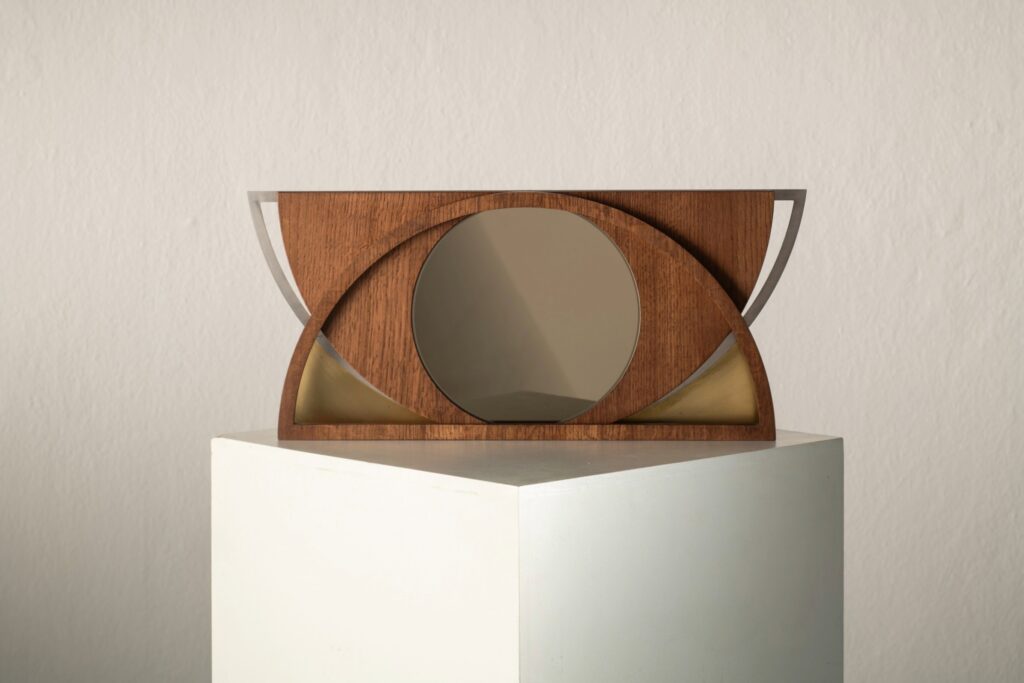
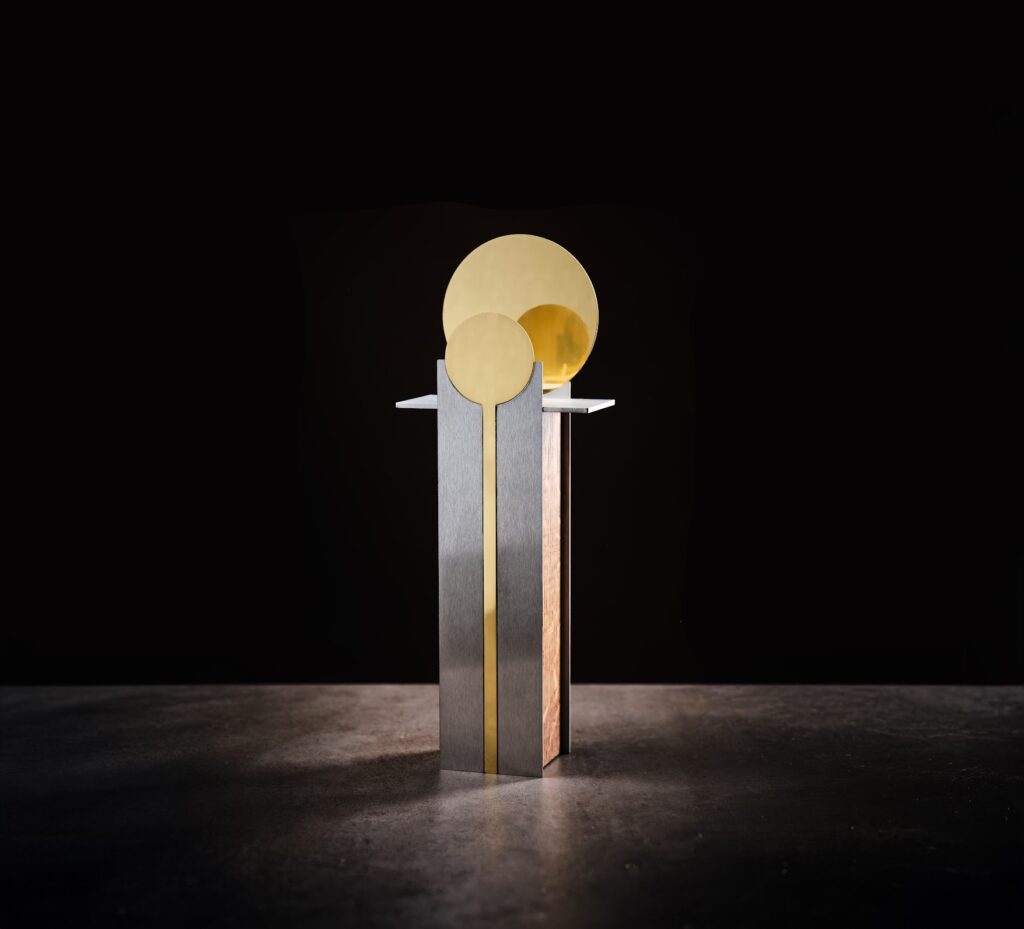
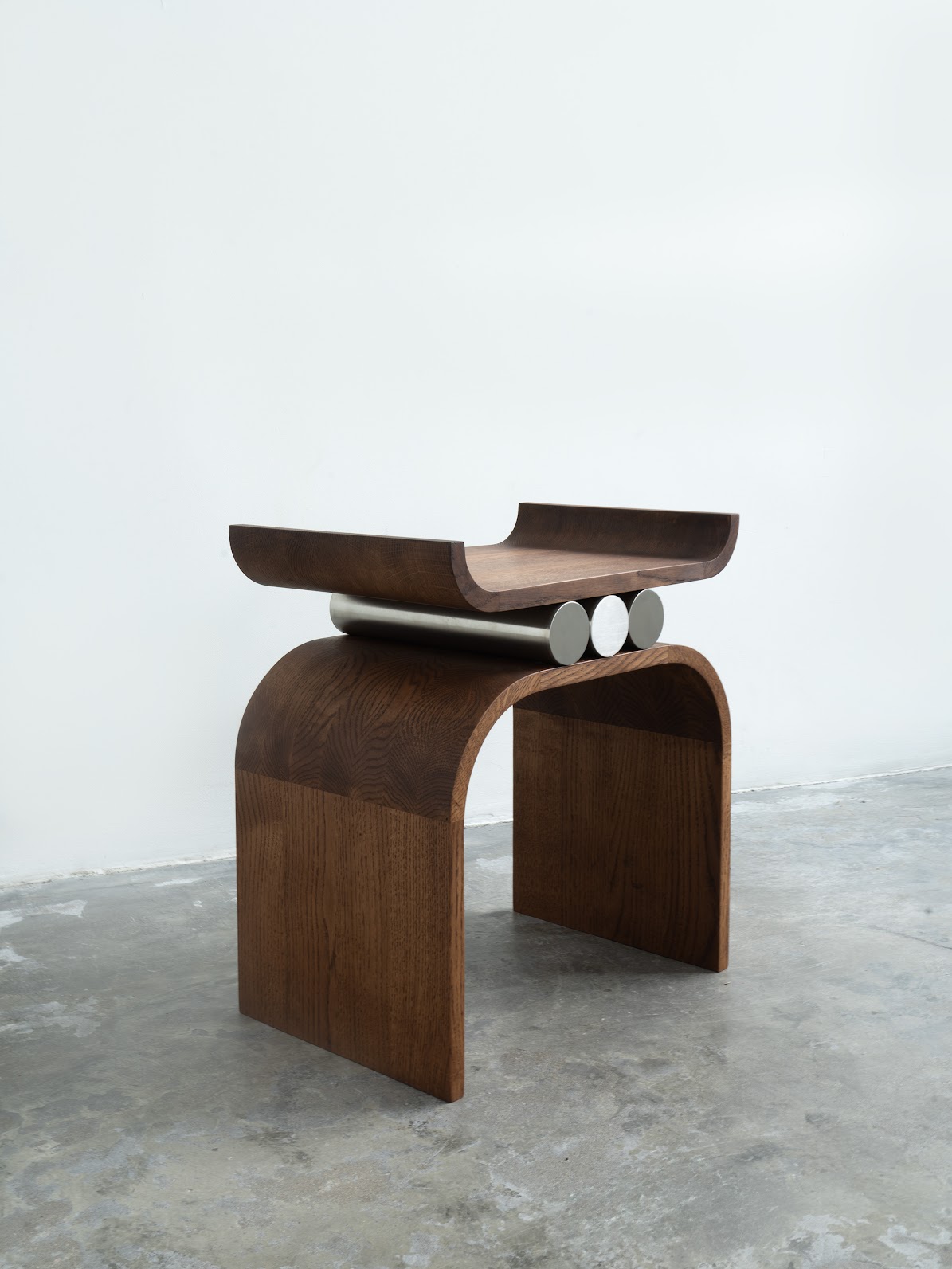
Looking at your designs, a recurring dialogue emerges between two seemingly contrasting materials: the organic warmth of wood and the cool precision of satin-finished metal. Through your sculptural forms, this contrast seems to evolve into a surprisingly harmonious balance.
Where does this particular affinity for such different materials come from? Is it driven by aesthetic and structural exploration, or is there a more personal, almost emotional dimension that draws you to bring them together?
When I started, I used only stainless steel because of its durability and quality. It was a rational choice. But gradually, I began to feel that steel’s precision and coldness needed something to counterbalance them. I also became more confident working with more than one material without feeling overwhelmed as I tried to combine them.
In a way, you could say that the addition of other materials represents my development as a designer. Currently, I sense that my material choices have moved away from the rational and toward the emotional. Now I allow myself to explore and combine them while following a more emotional, creative path, where balance comes not only from shapes but from materials too.
Lithuania has a deep-rooted connection to its forests and a long-standing tradition of woodworking.
To what extent has this cultural heritage shaped your sensitivity to different wood species and their unique qualities? When selecting wood for your creations, how much of your decision is guided by the material’s technical and sensory characteristics, and how much by memories of the places and traditions you grew up with?
Since I was little, I have seen oak wood being used by different Lithuanian craftspeople, not only for its properties but also because of its close connection to Lithuanian culture. We have protected and respected it for generations. Choosing this material creates a sense of quality intertwined with tradition.
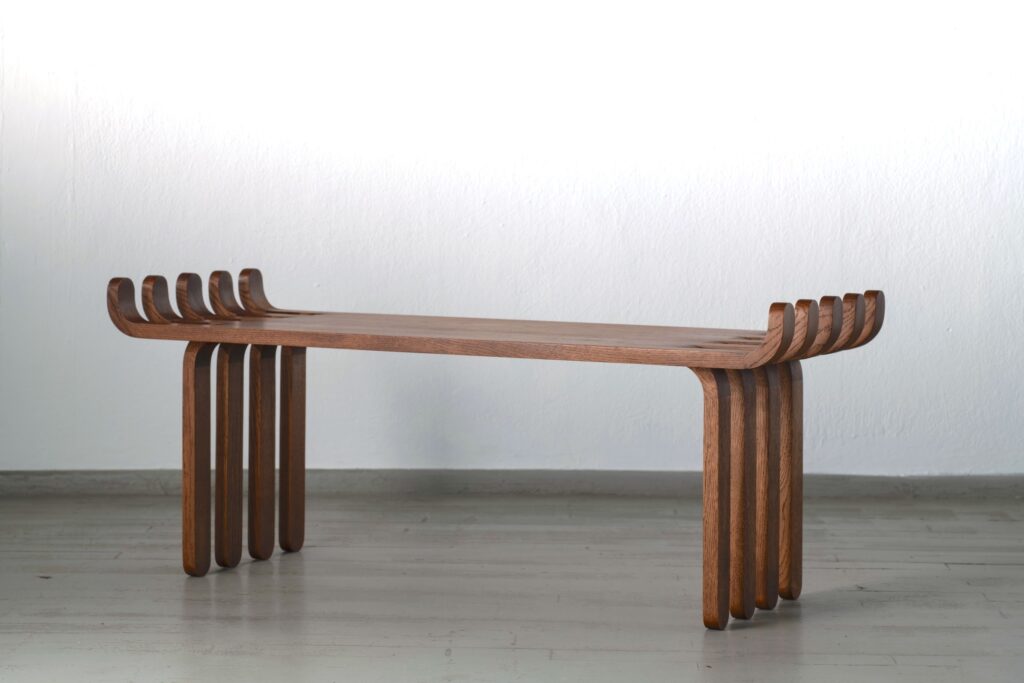
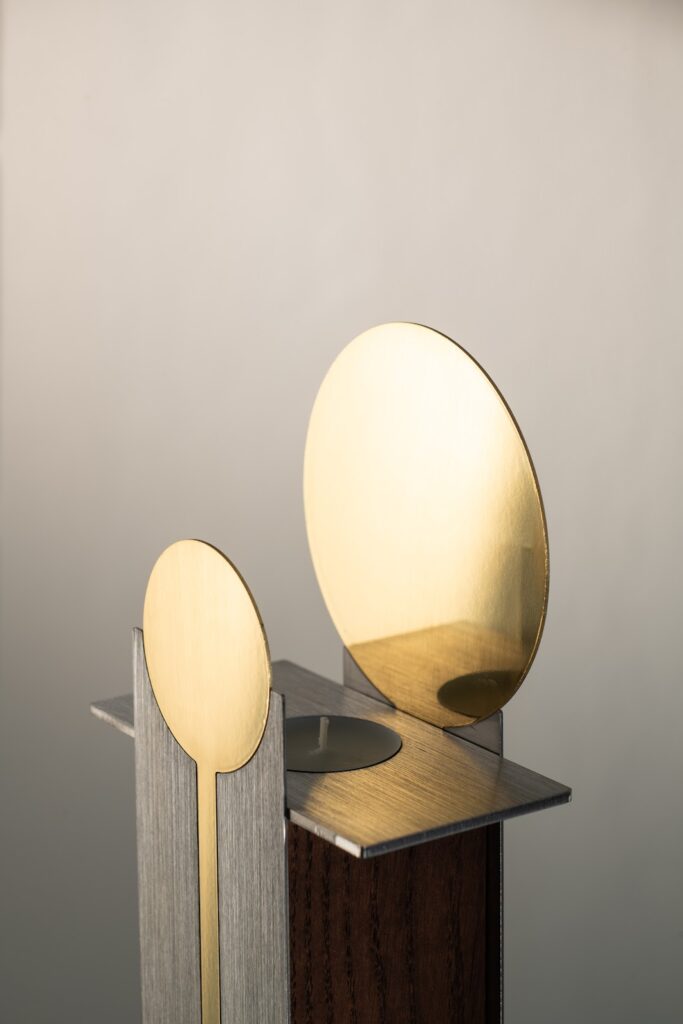
But I sense that my choice is often guided by the material’s color, grain, and tactility, which balance warmth and strength across different types of objects. Although it is a strong, durable material, bent details in my designs soften it slightly and highlight its plasticity and adaptability. Combined with stainless steel and brass details, this wood becomes a base where different shapes can mix, change, and finally settle into a harmonious composition.
–

